Metal Laser Cutting: How It Works, Types, and Materials
24 min
- What Is Metal Laser Cutting?
- How Does the Metal Laser Cutting Process Work?
- Types of Lasers Used for Metal Cutting
- What Metals Can Be Laser Cut?
- Metal Laser Cutting Materials Compared
- Factors That Affect Metal Laser Cutting Quality
- Advantages and Limitations of Metal Laser Cutting
- Metal Laser Cutting Applications
- Metal Laser Cutting Design Guidelines
- Metal Laser Cutting vs. Other Metal Cutting Methods
- CNC Metal Laser Cutting for Custom Parts
- FAQs About Metal Laser Cutting
Key Takeaways
- Fiber lasers are widely used for industrial metal cutting because of their efficiency and ability to process reflective metals.
- Metal laser cutting uses a focused beam and assist gas to produce precise profiles without profile-specific punches or dies.
- Common materials include carbon steel, stainless steel, aluminum, copper, brass, and titanium, with different process requirements for each.
- Cutting quality depends on material, thickness, laser power, speed, focus, assist gas, and machine configuration.
- Laser cutting is particularly useful for complex profiles, prototypes, custom parts, and production runs where dedicated tooling is not economical.
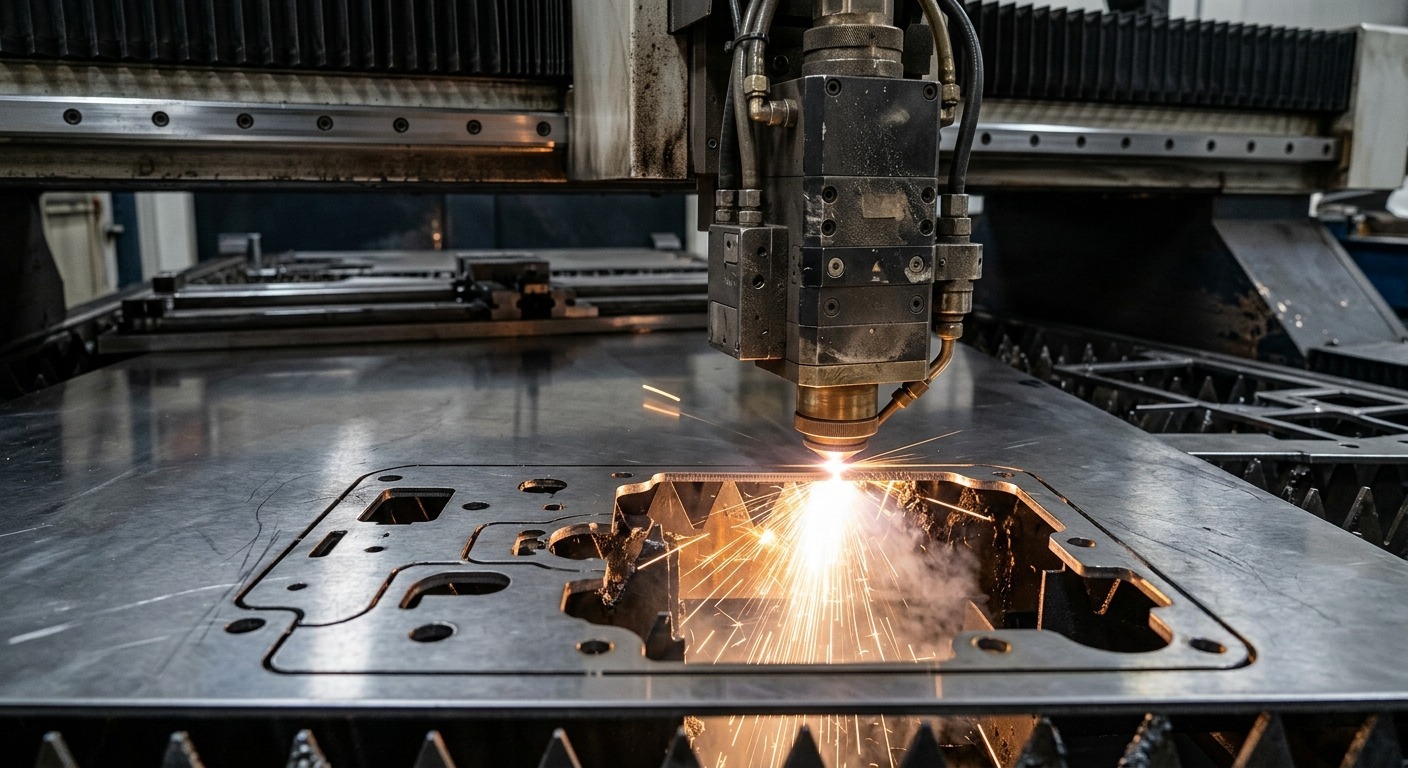
Fiber laser cutting stainless steel sheet
Many sheet metal parts can now be produced without dedicated profile tooling. A metal laser cutting machine reads a 2D CAD file and cuts the required profiles, holes, slots, and other features directly from the sheet.
This makes laser cutting particularly useful for custom parts, prototypes, and short production runs. When the geometry changes, the cutting program can be updated without manufacturing a new punch or die.
Need a Custom Laser-Cut Part?
Have a DXF, STEP file, or drawing ready? JLCCNC provides custom sheet metal fabrication with laser cutting, bending, and finishing, with parts checked against manufacturing standards.

Precision Sheet Metal Fabrication
Professional manufacturing, fast turnaround, and quality assurance.
What Is Metal Laser Cutting?
Metal laser cutting is a thermal material removal process in which a focused laser beam delivers concentrated energy to a small area of metal, raising the temperature at that point rapidly enough to melt, vaporize, or ignite the material. A high-pressure stream of assist gas, oxygen, nitrogen, or compressed air depending on the application, blows the molten or combusted material out of the cut zone, leaving a narrow, clean-edged kerf.
If you want to compare laser cutting with the other ways sheet metal can be cut, here’s the guide to sheet metal cutting methods and their typical accuracy.
How Does Laser Cutting Metal Work?
The physics breaks down into three distinct cutting mechanisms depending on the material, laser type, and assist gas:
Fusion cutting uses an inert gas (nitrogen) to blow molten metal out of the kerf without chemical reaction. The laser alone provides all the cutting energy. This produces oxide-free edges, important for stainless steel and aluminum applications where post-cut oxidation would affect surface quality or subsequent finishing.
Reactive cutting (flame cutting) uses oxygen as the assist gas, which reacts exothermically with the metal during cutting. This chemical reaction supplements the laser energy, allowing faster cutting speeds and greater thickness capability, particularly on mild steel. The trade-off is an oxidized edge that may require cleaning before coating or welding.
Vaporization cutting applies primarily to very thin materials and some non-metals, where the material is vaporized directly rather than melted. Less common in metal laser cutting applications.
Why Is Laser Cutting a Non-Contact Process?
The laser beam never touches the metal. There's no physical tool pressing against the workpiece, no blade edge deflecting under force, no punch impacting the sheet surface. The energy delivery is optical, focused light, and the assist gas delivery is pneumatic. This matters for several practical reasons: there's no cutting force that would deflect thin material or distort small features, there's no tool wear that would change cutting geometry over time, and there's no setup-to-setup variation from tool condition changes.
What Is the Role of CNC in Metal Laser Cutting?
The CNC system translates a digital CAD profile into coordinated axis motion, moving the cutting head (or the workpiece, depending on machine configuration) along the programmed path while simultaneously controlling laser power, pulse frequency, cutting speed, focus position, and gas pressure.
Modern metal laser cutting machines integrate these parameters into a coordinated process. The operator does not have to manually adjust power for each section. The machine can automatically adjust parameters based on feature type (straight edge, curve, internal corner, small hole) because different geometries require different parameters for consistent edge quality.
How Does the Metal Laser Cutting Process Work?
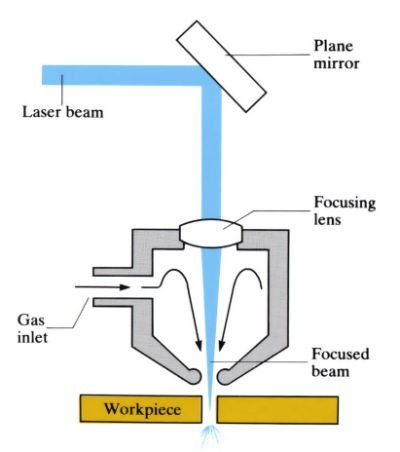
(open university) diagram showing metal laser cutting.
CAD Design and File Preparation
The process starts in CAD. For metal laser cutting, parts are typically designed as 2D flat profiles, DXF or DWG format for most machines, representing the final flat sheet geometry. 3D CAD models of folded sheet metal parts need to be unfolded to their flat blank before laser cutting, which most CAD packages handle automatically with appropriate bend allowance settings.
Nesting software then arranges multiple parts on a standard sheet size to minimize material waste and maximize material utilization. A well-nested sheet of 3mm stainless steel might carry dozens of different parts from the same batch, all cut in a single uninterrupted machine cycle. Poor nesting wastes material; good nesting is a meaningful cost driver on material-intensive parts.
Machine Setup and Material Positioning
The metal sheet loads onto the cutting table, typically a slat bed that supports the material while allowing the laser beam and assist gas to pass through beneath the kerf. Sheet positioning is registered against fixed reference stops to ensure the cut profiles land in the correct location on the sheet relative to edges and other features.
For thin materials, the sheet can usually lie flat without additional clamping. Its own weight provides adequate stability because laser cutting generates essentially no mechanical cutting force. For very thick plate, magnetic or mechanical hold-downs prevent the material from shifting, though the non-contact nature of laser cutting means workholding requirements are significantly simpler than for machining.
Laser Focusing and Piercing
Before the cutting path begins, the laser must pierce through the full material thickness at each contour start point. Piercing uses elevated power and sometimes a modified pulse strategy to blow a clean entry hole through the material without excessive spatter that would contaminate the cutting optics or damage the workpiece surface.
The focal point of the laser beam sits at a precisely controlled depth, typically at the material surface or slightly below it, optimized for the material and thickness being cut. Focus position is one of the most sensitive parameters in the metal laser cutting process: a beam focused too far above or below the surface produces a wider kerf, poorer edge quality, and reduced cutting efficiency. Modern machines use capacitive height sensing on the cutting head to automatically maintain constant standoff distance as the sheet surface varies.
Cutting and Material Removal
The cutting head traverses the programmed profile at the set cutting speed while laser power and pulse frequency maintain consistent energy delivery to the kerf. Straight lines can be cut at maximum speed for the material and thickness. Curves and small features may require lower cutting speeds to maintain dimensional accuracy through changes in geometry. CNC control can automatically adjust speed through corners and radius transitions.
Internal features, such as holes, slots, and pockets, are typically cut before the outer profile, which ensures parts remain supported throughout cutting rather than falling prematurely.
Assist Gas and Cut Quality
The assist gas serves multiple functions: it blows molten material out of the kerf (the primary function), protects the focusing optics from spatter, cools the cut zone, and in the case of oxygen, provides additional cutting energy through oxidation reaction.
Nitrogen cutting produces the cleanest edges on stainless and aluminum, no oxidation, minimal discoloration, bright metallic edge directly from cutting. It's also slower and requires higher laser power than oxygen-assisted cutting on equivalent material. Oxygen cutting on mild steel is faster and handles thicker material but produces an oxidized (black or blue) edge that needs cleaning before powder coating or welding if oxidation is unacceptable.
Compressed air is a cost compromise used for thin mild steel and some aluminum applications where edge quality requirements are moderate, the cutting performance is between nitrogen and oxygen, and gas cost is a fraction of either.
Inspection and Post-Processing
After cutting, parts are typically checked against their 2D profile, dimensional verification of critical features using calipers, gauges, or CMM for precision requirements. Edge quality is assessed visually and by tactile check of burr presence.
Post-processing for laser-cut metal parts commonly includes deburring (thin slag or micro-burr on the cut edge underside), cleaning of the oxide layer if nitrogen cutting wasn't used, and preparation for subsequent operations, bending, welding, powder coating, or assembly.
Types of Lasers Used for Metal Cutting
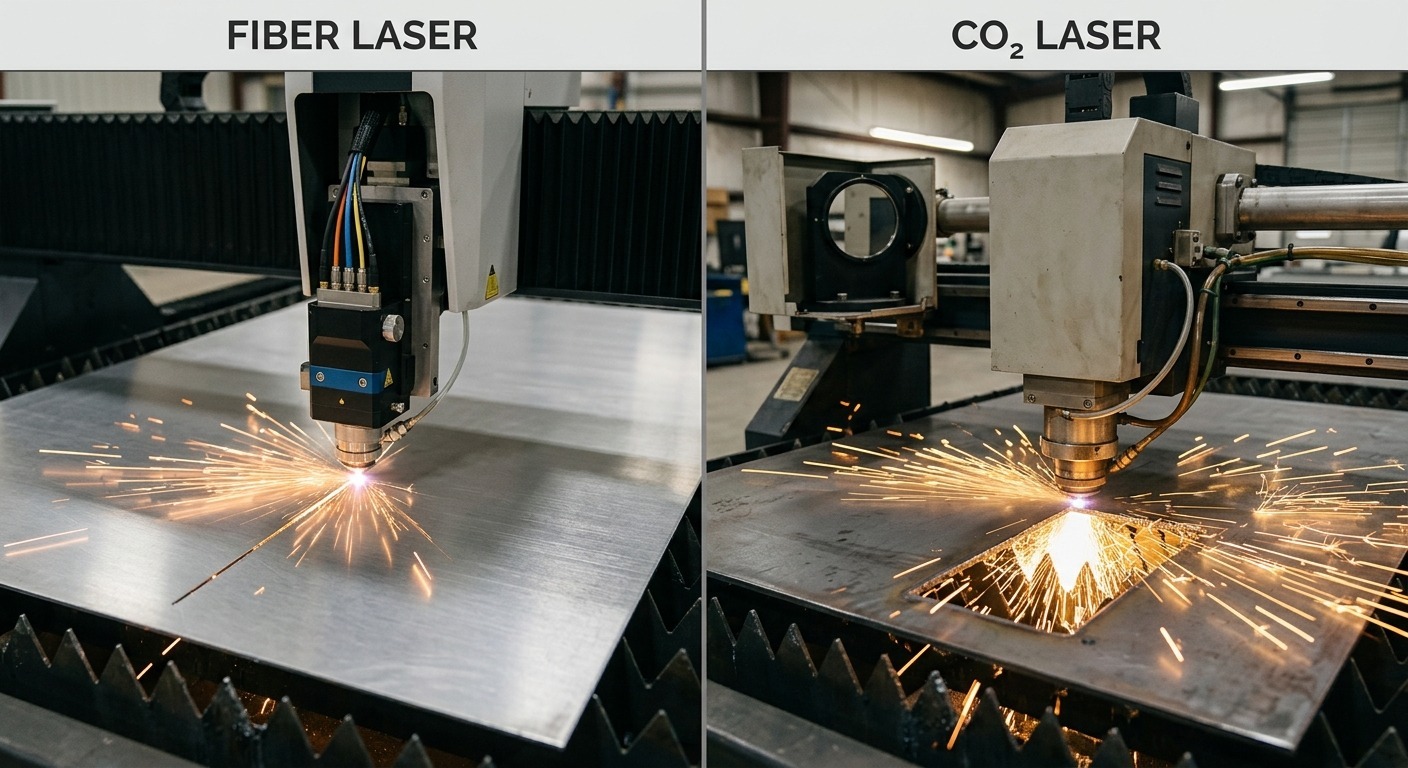
Fiber vs. CO₂ laser cutting systems
Three main laser technologies appear in metal laser cutting machines, each with different characteristics that suit different applications.
Fiber Laser Cutting
Fiber lasers generate their beam through a doped optical fiber medium and deliver it to the cutting head through a fiber optic cable. This produces a beam with a wavelength of approximately 1 µm, about ten times shorter than a CO₂ laser, which metals absorb significantly more efficiently.
The practical consequences of this better absorption: fiber lasers cut reflective metals (aluminum, copper, brass) that would damage a CO₂ machine, achieve faster cutting speeds on thin to medium metal thicknesses, consume less electrical power for equivalent cutting performance, and require essentially no optical alignment maintenance because the beam path is enclosed in the fiber.
Fiber laser cutting has largely displaced CO₂ for new metal cutting machine purchases. For thin to medium steel (under 20mm), aluminum, and reflective metals specifically, fiber laser is the current standard. High-power fiber systems (12-30 kW) now cut thick mild steel that was previously CO₂ territory.
CO₂ Laser Cutting
CO₂ lasers generate their beam through an electrically excited gas mixture and deliver it via a series of mirrors to the cutting head. The 10.6 µm wavelength is efficiently absorbed by organic materials, which is why CO₂ lasers excel at cutting wood, acrylic, and plastics, and adequately absorbed by most metals.
On thick mild steel (above 20mm), CO₂ lasers with oxygen assist have historically produced better edge quality than equivalent-power fiber systems, though high-power fiber has largely closed this gap. CO₂ machines are still found in facilities where the cutting mix includes significant non-metal work alongside the metal laser cutting.
Nd:YAG and Other Laser Technologies
Nd:YAG lasers produce a 1.06 µm wavelength similar to fiber, metals absorb them well, but they're pulsed rather than continuous-wave in most metal cutting applications. They're used for precision micro-cutting, fine hole drilling, and specialty applications rather than general sheet metal laser cutting.
Disk lasers and direct diode lasers are emerging technologies that offer efficiency advantages in specific applications, but fiber laser remains the dominant technology for metal laser cutting production environments.
Fiber Laser vs. CO₂ Laser for Metal Cutting
| Factor | Fiber Laser | CO₂ Laser |
|---|---|---|
| Wavelength | ~1 µm | 10.6 µm |
| Metal absorption | Higher | Lower |
| Thin metal speed | Faster | Slower |
| Thick steel (>25mm) | Competitive at high power | Traditional advantage |
| Reflective metals | Yes, copper, brass, aluminum | Limited, reflectivity risk |
| Electrical efficiency | 25-35% | 8-15% |
| Beam delivery | Fiber optic | Mirror system |
| Maintenance | Lower | Higher (mirror alignment) |
| Non-metal cutting | Limited | Yes, acrylic, wood, etc. |
| Capital cost | Higher to equivalent | Lower for older systems |
What Metals Can Be Laser Cut?
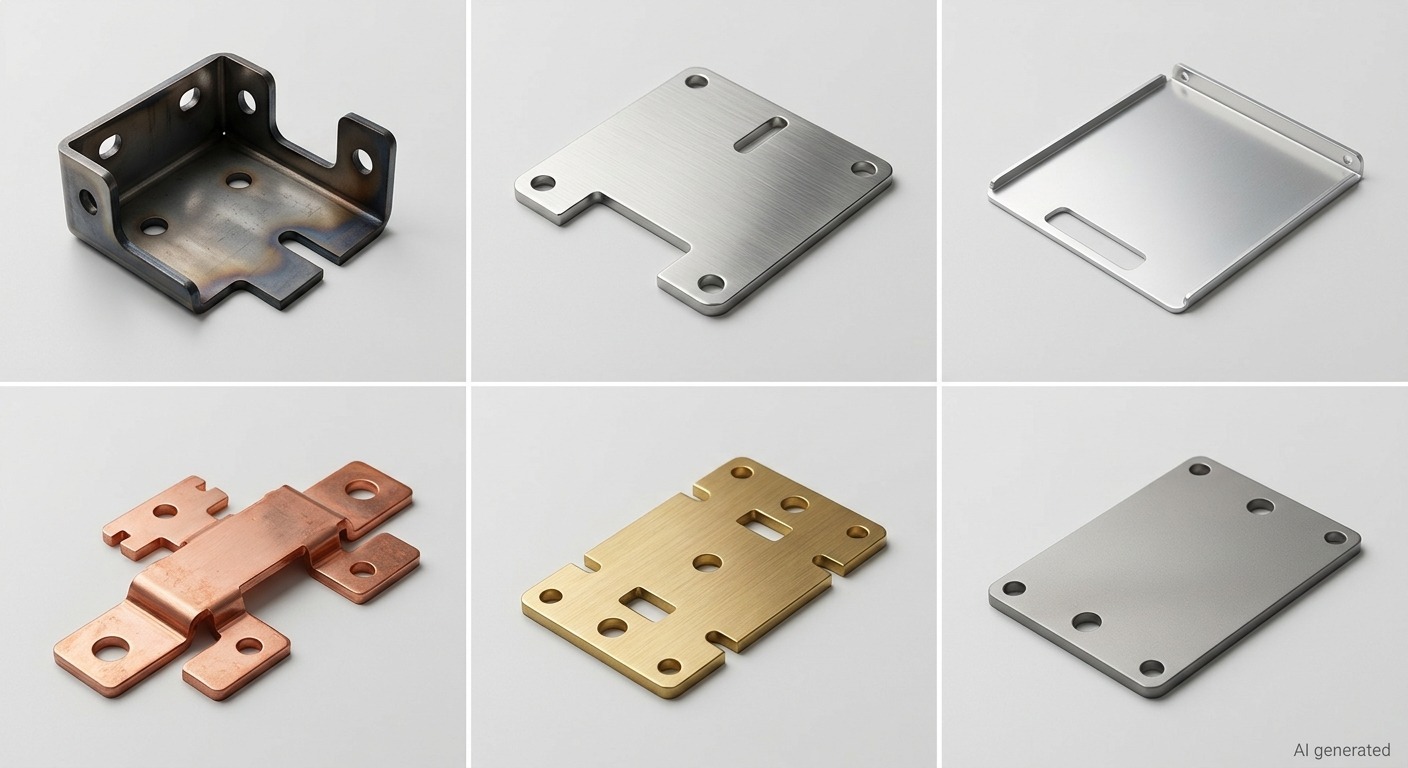
Finished laser-cut metal components
Carbon and Mild Steel
Mild steel is one of the most common materials for production laser cutting. It cuts efficiently and can provide good edge quality across a wide range of thicknesses. The iron content provides good laser energy absorption, and oxygen assist allows reactive cutting that handles thicknesses to 25mm or beyond on high-power machines.
Carbon steel in higher grades (medium and high carbon) cuts similarly to mild steel but may show hardening at the heat-affected zone, which matters for subsequent machining or drilling operations at the cut edge.
Stainless Steel
Stainless steel laser cutting often uses nitrogen assist to limit oxidation at the cut edge. Nitrogen can help produce a bright, oxide-free edge when surface appearance or subsequent finishing requirements make oxidation undesirable.
Stainless cuts cleanly from thin gauge through approximately 20mm on modern fiber laser machines, with edge quality that often requires minimal post-processing for most applications.
Aluminum
Aluminum's high thermal conductivity and reflectivity made it more challenging for older CO₂ laser systems. Reflected laser energy could damage optical components and destabilize the cutting process. Fiber lasers absorb this reflected energy in the delivery fiber rather than returning it to the source, which makes aluminum laser cutting practical on modern machines.
The high thermal conductivity of aluminum means heat dissipates rapidly from the cut zone, requiring higher power or slower cutting speed to maintain consistent cut quality compared to steel at equivalent thickness.
Copper and Brass
Highly reflective metals, copper especially, were essentially impractical on CO₂ laser cutting machines. Fiber laser cutting handles copper and brass routinely, though they require higher laser power than steel at equivalent thickness due to their high reflectivity and thermal conductivity.
Laser-cut copper and brass are used for electrical components, decorative elements, heat-exchanger fins, and other parts that benefit from precise profiles.
Titanium and Specialty Metals
Titanium laser cutting works well because titanium's lower reflectivity and moderate thermal conductivity give good laser energy coupling. The material's tendency to react with oxygen at elevated temperatures means inert gas assist (argon or nitrogen rather than oxygen) is typically used for titanium laser cutting.
Nickel alloys, tool steels, and other specialty metals are laser-cuttable with appropriate parameters, though some materials require specialized process development and may not be available as standard services.
Metal Laser Cutting Materials Compared
| Material | Key Characteristics | Laser Cutting Considerations | Common Applications |
|---|---|---|---|
| Carbon Steel | High iron content, good absorption | Oxygen assist for reactive cutting; excellent speed on fiber laser | Structural components, brackets, frames, panels |
| Stainless Steel | Chromium alloy, corrosion resistant | Nitrogen assist required for oxide-free edge; higher gas cost | Food processing, medical, architectural, enclosures |
| Aluminum | High reflectivity, high thermal conductivity | Fiber laser required; higher power for thickness; nitrogen or air assist | Aerospace panels, electronics enclosures, automotive |
| Copper | Very high reflectivity, excellent conductor | Fiber laser required; high power; careful parameter control | Electrical components, heat exchangers, RF shielding |
| Brass | Copper-zinc alloy, moderate reflectivity | Fiber laser preferred; good edge quality; zinc fume management | Decorative parts, fittings, electrical connectors |
| Titanium | High strength-to-weight, reactive at temperature | Inert gas assist; good coupling; careful heat management | Aerospace structures, medical implants, marine hardware |
Factors That Affect Metal Laser Cutting Quality
Material Type and Thickness
Material composition determines how efficiently the laser energy converts to cutting action and how quickly heat dissipates from the kerf. Thick material requires more laser power, slower cutting speed, and more careful gas management than thin material, and the interaction of all these parameters determines whether the resulting edge is clean or shows dross, striations, or dimensional variation.
Laser Power
More laser power does not automatically produce better cuts. It can enable thicker material to be cut at a given speed or the same thickness to be cut faster, depending on the process parameters. An appropriate laser power level should provide complete cutting at the required speed while meeting the specified edge-quality requirements.
Cutting Speed
Too slow: excess heat input, wider heat-affected zone, possible material distortion, burning on thinner material. Too fast: incomplete cutting, rough striations on the cut face, dross attachment on the edge underside. The correct cutting speed for any material and thickness combination sits in a window determined by empirical testing, and machine manufacturers provide starting parameters, which are then refined for specific applications.
Dross, rough edges, warping, and inconsistent dimensions can often be traced back to cutting parameters or material behavior. Here’s the guide to the most common sheet metal cutting problems and how to avoid them.
Focus Position
The optimal focal position depends on the material, thickness, and cutting conditions. Focus position affects kerf geometry and edge quality. Machines with automatic focus adjustment can compensate for changes in material thickness.
Assist Gas
Gas type, pressure, and nozzle design determine how effectively molten material is removed from the kerf. Insufficient gas pressure leaves dross on the cut edge. Excessive pressure on thin material can cause turbulence that degrades cut quality. Nozzle diameter and standoff distance interact with gas pressure to determine the effective assist gas behavior at the kerf.
Kerf Width
Kerf width depends on the material, thickness, laser system, and cutting parameters. The CAM system accounts for kerf when generating the toolpath, so the programmed geometry can correspond to the required finished dimensions.
Heat-Affected Zone
The area immediately adjacent to the laser kerf experiences elevated temperature during cutting, which can alter material microstructure, create hardened zones in carbon steel, or discolor stainless steel. The heat-affected zone (HAZ) depends on cutting speed, laser power, material thickness, and thermal properties. Faster cutting can reduce heat input per unit length, but the resulting HAZ depends on the overall process parameters.
Advantages and Limitations of Metal Laser Cutting
High Precision and Repeatability
Dimensional accuracy can reach around ±0.1-0.2 mm on suitable laser-cut features, depending on the material, thickness, machine, and process conditions. More precise cuts are achievable with careful parameter optimization. Because the process is CNC-controlled and non-contact, it can provide consistent results across production runs. Unlike profile-specific mechanical tooling, the cutting geometry does not depend on punch or die wear.
Fast Cutting and Efficient Production
Modern high-power fiber lasers can achieve high cutting speeds on thin mild steel, although actual speed depends on material grade, thickness, laser power, geometry, and cut-quality requirements. Even on thicker stainless steel where cutting is slower, the elimination of tooling setup time means laser cutting is often faster in total job time than alternative processes for small to medium batches.
Complex Shapes and Fine Features
Internal holes, angled slots, complex curved profiles, and fine features can be cut from the same CNC program without profile-specific tooling changes. This geometric flexibility is what makes metal laser cutting particularly valuable for custom and prototype work, where the variety of shapes would require extensive tooling on alternative processes.
Low Tool Wear and No Physical Cutting Force
Laser cutting does not require profile-specific punches or dies, making it well suited to prototypes, custom parts, and changing production requirements.
Material and Thickness Limitations
Metal laser cutting has practical thickness limits. Cutting capacity varies substantially by laser power, machine configuration, material grade, and required edge quality. High-power fiber systems can cut steel, stainless steel, and aluminum well beyond the ranges available on lower-power machines. Beyond these thicknesses, plasma cutting or waterjet becomes more practical. Very reflective materials in thick section remain challenging even for fiber laser systems.
Heat-Affected Zones and Edge Quality
The HAZ is an inherent consequence of the thermal cutting process. For most structural and enclosure applications, the HAZ width (typically 0.1-0.5mm) is insignificant. For applications requiring post-cut machining at the edge, heat-hardened zones in carbon steel can cause tool wear problems. For appearance-critical stainless parts, heat tinting adjacent to the cut edge may require removal.
Metal Laser Cutting Applications
Brackets and Mounting Plates
Custom brackets, mounting plates, and structural connections are among the most common laser cut metal parts in production. The combination of precise hole locations, complex profile shapes, and immediate CNC repeatability makes metal laser cutting the natural process for these parts, typically in mild steel or stainless, cut flat and then bent to final geometry.
Enclosures and Panels
Electrical enclosures, equipment panels, and protective covers require precise hole patterns for connectors, switches, and fasteners, combined with clean edges for appearance and seal fit. Metal laser cutting handles all of this in a single operation, with the accuracy needed for gasketed enclosures where edge flatness and hole position affect sealing.
Automotive Components
Automotive sheet metal laser cutting covers a range from prototype body panels and structural brackets to production seat components, heat shields, and interior structural parts. The process suits automotive because it handles the volume of unique parts in vehicle development efficiently and scales to production quantities without tooling investment for each part.
Aerospace Components
Aerospace laser cutting applications include structural ribs and spars, access panels, brackets, and thin-wall titanium and aluminum structural parts. The material efficiency (minimal waste), dimensional accuracy, and ability to cut lightweight titanium and aluminum are well-matched to aerospace priorities.
Electronics and Electrical Parts
EMI shielding, bus bar profiles, connector housings, heat sink components, and circuit board mounting hardware are all commonly laser-cut metal parts in electronics manufacturing. Copper and aluminum laser cutting for electrical applications requires fiber laser technology specifically.
Industrial Machinery Components
Guards, housings, frames, and custom fittings for industrial equipment are natural metal laser cutting applications, typically in mild steel or stainless, produced in small batches with design variations between production runs that would require extensive tooling on alternative processes.
Metal Laser Cutting Design Guidelines
Hole Size and Feature Dimensions
A common starting rule is to keep the minimum hole diameter near the material thickness, although the practical limit depends on material, thickness, laser system, and required hole quality. For precision-fit holes (bearing bores, close-clearance fastener holes), design slightly oversize and machine to final dimension after laser cutting.
Minimum Feature Spacing
Features too close together, narrow tabs, thin webs between holes, receive excess heat from adjacent cuts and can distort or fail completely. Minimum spacing between holes or between a hole and a profile edge should be at least the material thickness, preferably more for thick material or heat-sensitive materials.
Kerf and Dimensional Accuracy
Account for kerf width when designing for tight-tolerance features. The kerf removes material from the cut edge, program the cut path accordingly. For mating parts that must fit together, consistent kerf compensation on both parts ensures the fit matches the design intent rather than depending on the residual material left by two separate kerf widths.
Sharp Corners and Small Features
External sharp corners are achievable in laser cut metal. Internal sharp corners (inside corners of a profile) will have a small radius determined by the laser beam diameter and cutting dynamics, typically 0.1-0.3mm. If truly sharp internal corners are required, design a small overcut at the corner or plan a secondary milling operation.
Designing for Material Thickness
The relationship between feature size and material thickness determines what's practical in metal laser cutting. Very thin features in thick material, a 2mm tab in 10mm plate, won't survive the cutting process or will be significantly distorted by the heat. Design features proportional to the material being cut.
Reducing Heat Distortion
Large flat parts in thin material can distort from the accumulated heat of many cuts across the sheet. Sequencing cuts to work from the center outward, leaving tabs (micro-joints) that are manually broken after cutting, and choosing nitrogen assist to reduce heat input are all practical strategies. For distortion-critical thin parts, consider whether waterjet cutting might better suit the requirement.
Metal Laser Cutting vs. Other Metal Cutting Methods
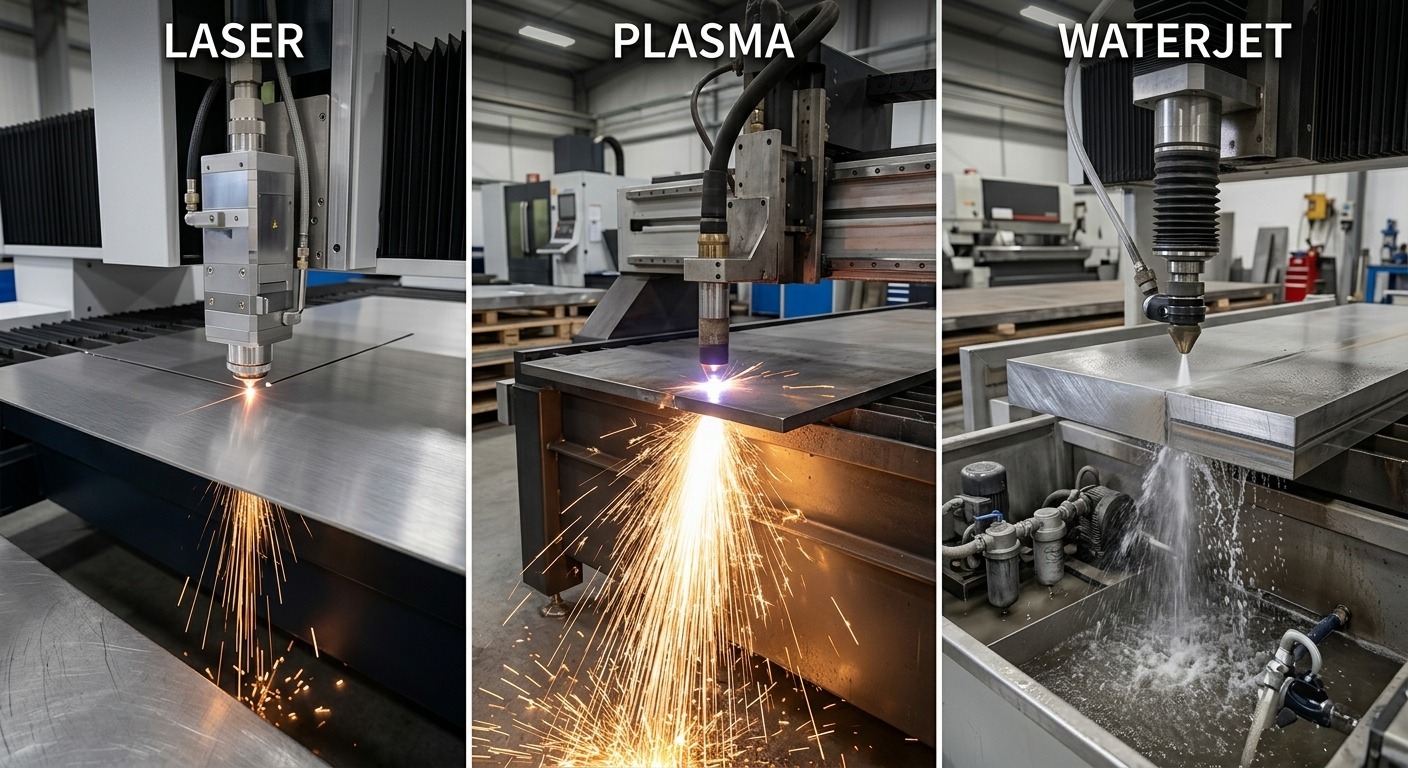
Laser, plasma, and waterjet cutting comparison
| Factor | Laser Cutting | Plasma Cutting | Waterjet Cutting | Mechanical (Punch/Saw) |
|---|---|---|---|---|
| Precision | ±0.1-0.2mm | ±0.5-1.0mm | ±0.1-0.3mm | ±0.1-0.5mm |
| Edge quality | Excellent | Moderate | Excellent | Good (punch) |
| Max thickness | 25-30mm steel | 50mm+ | 200mm+ | Material-dependent |
| Heat-affected zone | Small | Larger | None | None |
| Cutting speed | Very fast (thin-medium) | Fast | Slow | Fast (punch) |
| Complex geometry | Excellent | Good | Excellent | Limited (punch shape) |
| Tooling required | None | None | None | Yes (punches/dies) |
| Setup cost | Low | Low | Low | High (tooling) |
| Operating cost | Medium | Lower | Higher | Lower at volume |
| Reflective metals | Yes (fiber) | No | Yes | Yes |
Laser Cutting vs. Plasma Cutting
Plasma cutting handles thicker material than laser and has lower operating cost, but produces rougher edges with larger heat-affected zones. For structural work where dimensional precision matters less than cut speed and material thickness, plasma is appropriate. For parts where edge quality, tight tolerances, or fine features are required, metal laser cutting is the better process.
Laser Cutting vs. Waterjet Cutting
Waterjet has no heat-affected zone, the water abrasive removes material without thermal input, which matters for heat-sensitive materials or parts that can't tolerate microstructure changes. Waterjet is significantly slower than laser cutting metal on thin-to-medium thickness, and operating cost (abrasive consumption, pump maintenance) is higher. For very thick material, heat-sensitive materials, or parts where HAZ is unacceptable, waterjet is the better choice.
If heat input is a concern, waterjet can be a better option despite its slower cutting speed. Here’s the guide comparing waterjet and laser cutting in more detail.
Laser Cutting vs. Mechanical Cutting
Punching and sawing have lower per-part cost at high volume where the tooling investment amortizes fully, and for very simple profiles.
CNC Metal Laser Cutting for Custom Parts
From CAD File to Laser-Cut Part
A DXF or STEP file uploads to the CAM software, which generates the cutting program including pierce points, cut path sequencing, approach and exit moves, and parameter selection based on material and thickness. Review confirms the cut strategy, then production begins.
This file-to-part speed is one of the most practical advantages of CNC metal laser cutting for custom work, a design change is a CAD file revision, not a tooling modification.
CNC Laser Cutting for Prototypes
Prototype laser-cut parts can often be produced quickly because the process does not require dedicated profile tooling, although lead times vary by supplier, material, quantity, and finishing requirements.
CNC Laser Cutting for Production Parts
Production laser cutting scales well because CNC repeatability means every part in a production run has the same dimensions as the first. Nesting optimization improves material utilization across larger sheets and higher quantities. For parts where the variety or volume doesn't justify dedicated tooling (stamping dies, punch tooling), laser cutting remains cost-competitive at surprisingly high volumes.
Combining Laser Cutting With Sheet Metal Fabrication
Laser cutting is typically the first operation in a sheet metal fabrication sequence. Flat profiles are laser cut, then bent on a press brake, then welded or fastened, then surface finished. The precision of laser cut hole locations and profile dimensions flows through to bend accuracy and assembly fit, a poorly cut flat blank produces fitting problems at every subsequent stage, while a precisely cut blank simplifies everything downstream.
FAQs About Metal Laser Cutting
Q: What is metal laser cutting?
Metal laser cutting is a CNC-controlled thermal process that uses a focused laser beam to melt or vaporize metal along a programmed path, with assist gas removing the molten material to produce a clean kerf. It's a non-contact process, no physical tool touches the workpiece, capable of cutting complex profiles with tolerances of ±0.1-0.2mm in a single automated operation.
Q: How does metal laser cutting work?
A focused laser beam melts or vaporizes the metal while assist gas removes molten material from the kerf. CNC control coordinates the cutting path, power, speed, focus, and gas delivery.
Q: What metals can be cut with a laser?
Fiber laser technology handles reflective metals (copper, brass, aluminum) that CO₂ machines struggle with. The practical limits are material thickness (most metals to 20-25mm on standard equipment) and very high-reflectivity copper alloys in thick section.
Q: What type of laser is best for cutting metal?
Fiber laser is the current standard for metal laser cutting across most applications. It absorbs into metal more efficiently than CO₂, handles reflective materials, runs at lower operating cost, and requires less maintenance. CO₂ lasers retain a role in facilities where non-metal cutting is part of the workload. For pure metal laser cutting, fiber laser is the practical choice.
Q: How thick of metal can a laser cut?
Standard metal laser cutting machines handle mild steel to 20-25mm, stainless steel to 15-20mm, and aluminum to 12-15mm. High-power fiber laser systems (15-30 kW) push these limits further, 30mm mild steel and 25mm stainless on the most powerful commercial systems. Beyond these ranges, plasma cutting or waterjet is typically more practical for the thickness involved.
Popular Articles
• 9 Sheet Metal Cutting Problems and Solutions
• Hole cutting in sheet metal: techniques, tolerances and applications
• Introduction to Sheet Metal Processing: Techniques and Tools for Precision
• Bending and Forming Technology in Sheet Metal Processing
• Laser cutting technology in sheet metal processing
Keep Learning
Galvanized Sheet Metal: Grades, Specs & When to Use It
Galvanized Sheet Metal: Grades, Specs & When to Use It A design engineer specs "galvanized sheet metal" on a drawing and sends it out for quotes. Three shops come back with three different prices, and one of them asks a follow-up question the others didn't: which gauge, which coating class, hot-dip or electro-galvanized? That question is the difference between a part that survives outdoors for fifteen years and one that starts showing rust spots after eighteen months — and it's the kind of detail that......
Custom Sheet Metal Fabrication: How the Process Works From Design to Delivery
Custom Sheet Metal Fabrication: How the Process Works From Design to Delivery A stock enclosure almost fits. The mounting holes are close but not quite right, the depth is half an inch too shallow, and the vendor's next size up is twice the volume you actually need. This is the point where most people start looking into custom sheet metal fabrication — not because they set out to design a part from scratch, but because nothing off the shelf actually solves the problem. Custom fabrication sounds like i......
Sheet Metal Assembly: How Fabricated Parts Come Together
Sheet Metal Assembly: How Fabricated Parts Come Together Cutting and bending gets a lot of attention because that's where a flat sheet visibly turns into a 3D part. But a single bracket by itself rarely finishes the job — most real sheet metal products are assemblies, multiple formed pieces joined into one working unit, and that assembly step is where a lot of designs quietly succeed or fail. A part that measured perfectly on its own can still not fit once it's supposed to mate with three other pieces......
Sheet Metal Bender: Types, Specs & How to Choose the Right Machine
Sheet Metal Bender: Types, Specs & How to Choose the Right Machine Every sheet metal bracket, enclosure, and panel eventually passes through a bender of some kind — that's the machine, not the process. Our guide on sheet metal bending covers how bending actually deforms metal — springback, minimum radius, bend allowance, and the core press brake and CNC press brake setups most shops run. This one goes further into the equipment side specifically: the less common bender types beyond the standard press ......
What Is Galvanized Metal? Process, Types & How It Works
What Is Galvanized Metal? Process, Types & How It Works Leave a piece of bare steel outside for a season and you'll see exactly why galvanizing exists. Rust doesn't wait for dramatic weather — a little humidity and a few weeks is enough to start eating into an unprotected surface. Galvanized metal solves that problem by giving steel a sacrificial layer of zinc that corrodes in its place, and it's done this job well enough that it's become the default choice for anything from highway guardrails to HVAC......
What Is Sheet Metal Fabrication? The Complete Guide
What Is Sheet Metal Fabrication? The Complete Guide Somewhere between a CAD file and a working enclosure sitting on your bench, a flat piece of metal gets cut, bent, joined, and finished into something that actually does a job. That's sheet metal fabrication — and if you've never ordered a part before, the term can feel bigger than it needs to be. Ask five people what "sheet metal fabrication" covers and you'll get five different answers: some think laser cutting, some think welding, some just picture......