What Is EDM? How Electrical Discharge Machining Works
10 min
- What Is EDM (Electrical Discharge Machining)? How It Works & Applications
- What Is EDM?
- Why Use EDM Instead of Conventional Machining?
- How the EDM Process Actually Works
- The Three Types of EDM
- Materials Suitable for EDM
- Where EDM Shows Up
- A Common Misconception Worth Correcting
- FAQ
What Is EDM (Electrical Discharge Machining)? How It Works & Applications
A mold shop needs to cut a cavity into hardened tool steel — the kind of material that would dull a carbide end mill before the cut is even halfway done. A medical device maker needs a slot 0.05mm wide in a titanium component, thinner than most drill bits can even produce. Neither job is solvable with a spinning cutting tool, because the material is either too hard, the geometry too fine, or both. That's the gap EDM was built to fill: a way to cut through electrically conductive material by eroding it with electricity instead of cutting it with force.
EDM sounds exotic until you see it running — no chips flying, no cutting fluid spraying, just a workpiece sitting in a tank while something invisible slowly eats away exactly the shape it's been programmed to remove. Understanding what's actually happening in that tank explains why EDM exists as a separate category from milling and turning, rather than just being a slower version of the same thing.
Need Precision EDM Parts?
Whether you need wire EDM for intricate titanium medical slots or sinker EDM for hardened tool steel cavities, JLCCNC has the equipment and expertise. We seamlessly combine EDM with 3-, 4-, and 5-axis CNC machining to deliver complex parts to print.

Precision CNC Machining Service
Professional manufacturing, fast turnaround, and quality assurance.
What Is EDM?
EDM, or Electrical Discharge Machining, is a non-contact manufacturing process that removes material from a workpiece using controlled electrical sparks rather than a physical cutting tool. An electrode — the tool — and the workpiece are both submerged in a dielectric fluid, and rapid electrical pulses jump across the small gap between them. Each spark generates intense, localized heat that melts and vaporizes a microscopic amount of material, and the dielectric fluid flushes that eroded debris away and helps control the process. Repeat that thousands of times per second and, cumulatively, the material erodes into the shape the electrode's path describes.
The key requirement, and the one limitation that rules out an entire category of materials: the workpiece has to be electrically conductive. EDM works on metals and some conductive ceramics, but it can't touch plastic, glass, or most composites — there's nothing for the spark to erode.
Why Use EDM Instead of Conventional Machining?
EDM earns its place in a shop for reasons that have nothing to do with speed — in most cases it's meaningfully slower than milling or turning the same volume of material. What it offers instead:
It doesn't care how hard the material is. Since EDM erodes material electrically rather than cutting it mechanically, hardened tool steel, tungsten carbide, and other materials that would rapidly destroy a conventional cutting tool machine just as readily as mild steel does. Hardness that would mean constant tool changes and poor tolerances on a mill is a non-issue for EDM.
It produces geometry conventional tools physically can't reach. A sharp internal corner, a narrow deep slot, a complex 3D cavity — a rotating cutting tool has a minimum radius it can't get below, and physical access constraints a non-contact spark doesn't share. EDM can hold a genuinely sharp internal corner where milling would always leave a rounded one dictated by cutter diameter.
It applies essentially no mechanical force to the workpiece. Because there's no physical cutting force, EDM doesn't induce the kind of stress or distortion that aggressive milling can cause in thin-walled or delicate parts — a meaningful advantage for fragile geometry that would flex or chatter under a conventional cutting tool.
The tradeoff is real, though: EDM is slower, generally more expensive per part, and only works on conductive materials. It's the right tool for a specific set of problems, not a general-purpose replacement for milling or turning.
How the EDM Process Actually Works
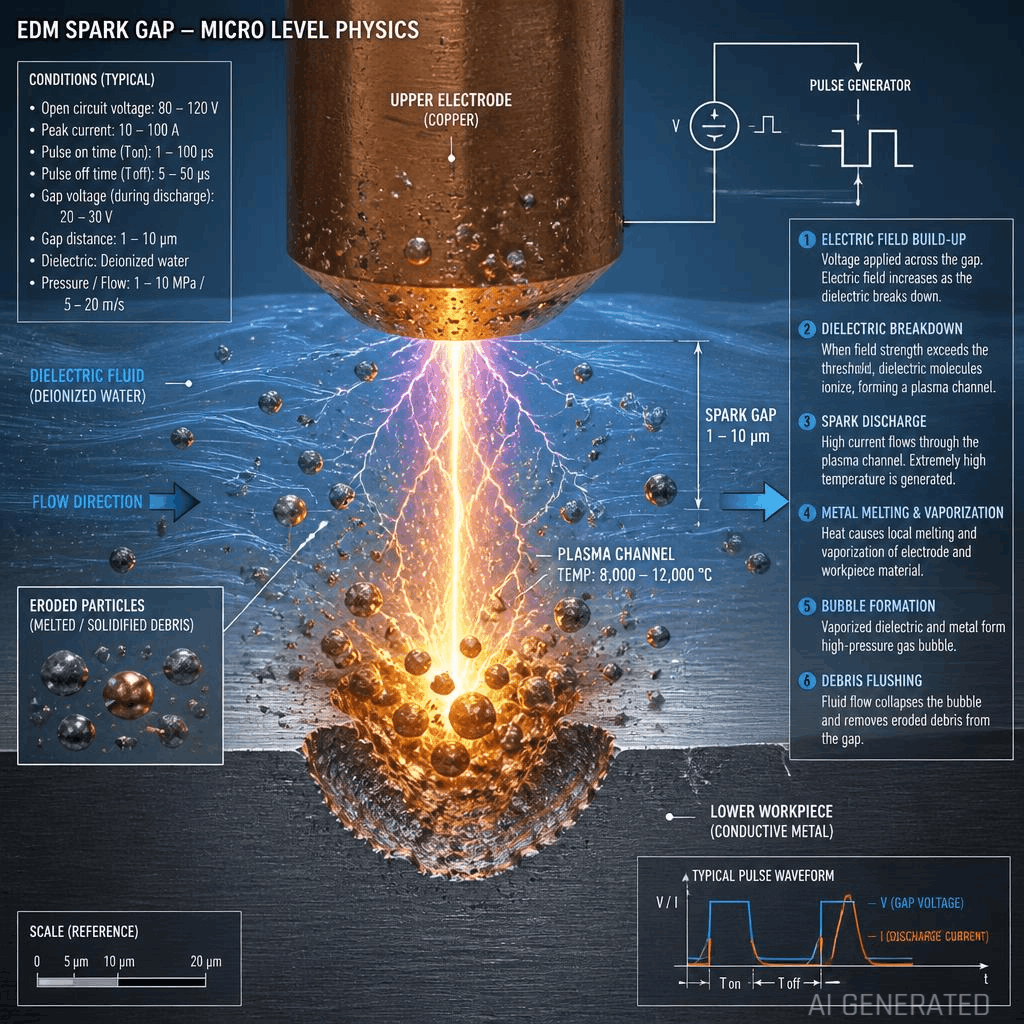
The spark gap. The electrode never touches the workpiece — a small, precisely maintained gap (often a fraction of a millimeter) separates the two. Get this gap wrong and the process either won't spark reliably or risks a short circuit; maintaining it consistently is one of the things the machine's control system is actively managing throughout the cut, not something set once and forgotten.
Dielectric fluid. This insulating fluid — commonly deionized water for wire EDM, specialized oil for sinker EDM — does three jobs at once: it acts as an insulator that lets the spark gap build voltage before discharging, it flushes eroded debris out of the cutting zone so it doesn't interfere with subsequent sparks, and it cools both the electrode and workpiece. A dielectric system that isn't flushing debris effectively is a common, under-appreciated cause of inconsistent cut quality — the erosion process itself is often less variable than how cleanly the byproducts get cleared away.
Material removal rate. Each individual spark removes a genuinely tiny amount of material — this is why EDM is slow relative to conventional cutting, and why it's chosen for precision and hard-material capability rather than raw material removal speed. Pulse frequency, current, and voltage settings all trade off against each other: higher energy per pulse removes material faster but leaves a rougher surface finish, while lower energy produces a finer finish at the cost of cycle time.
Electrode wear. Since the electrode is also exposed to the same electrical discharge, it erodes too, just typically at a much slower rate than the workpiece (materials like copper and graphite are chosen partly for their relatively low wear rate). On processes where electrode shape precision matters — sinker EDM especially — accounting for and compensating for electrode wear over the course of a long job is a real part of running the process well, not a minor detail.
The Recast Layer (White Layer): Because EDM relies on melting and vaporizing metal, a microscopic layer of melted material rapidly solidifies on the cut surface. This "recast layer" is exceptionally hard but often brittle, and it can contain micro-cracks. For highly stressed aerospace or medical components, this layer often must be removed via chemical etching or polishing after the EDM process.
The Three Types of EDM
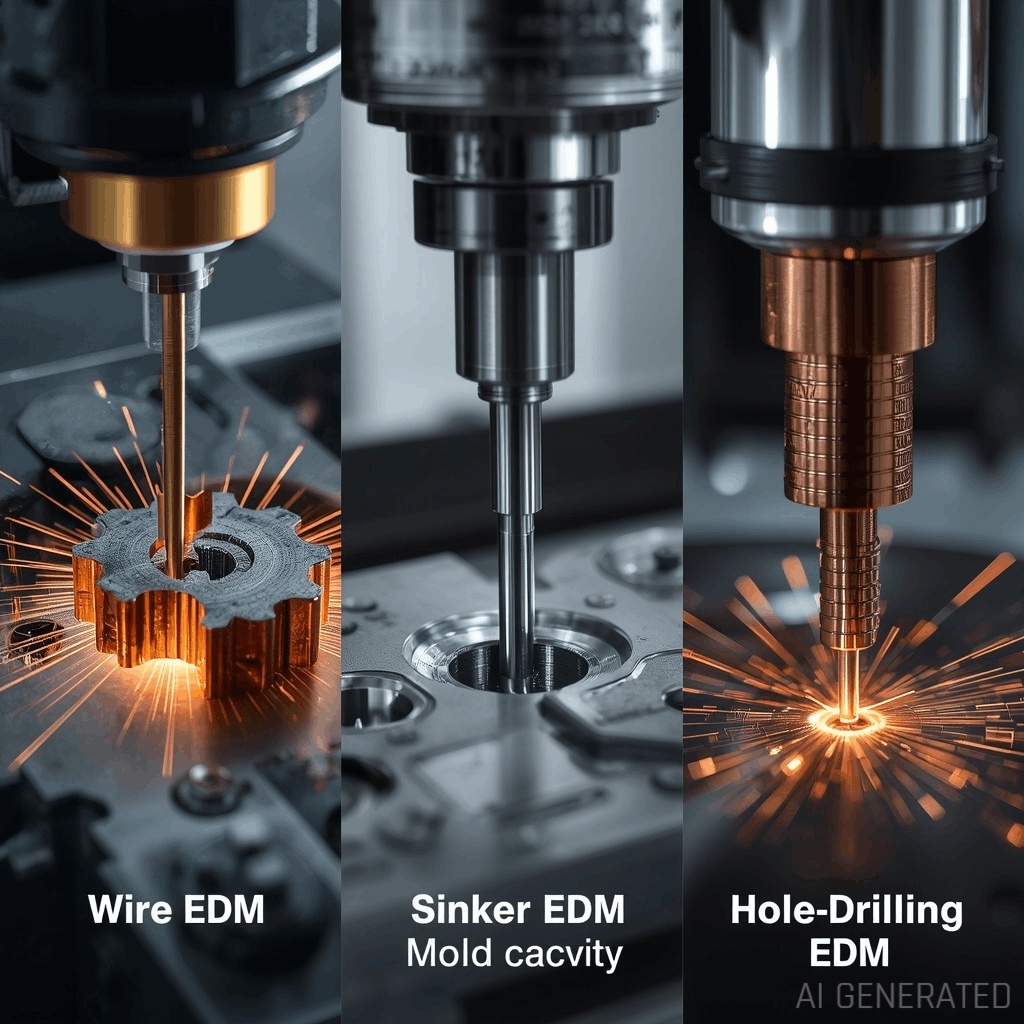
EDM isn't one machine — it's a family of processes that apply the same spark-erosion principle in different configurations, each suited to different geometry.
Wire EDM uses a continuously fed thin wire as the electrode, essentially cutting a 2D profile through the material the way a bandsaw would, but with no physical contact and far tighter tolerance capability. It's the choice for cutting intricate outlines, slots, and through-features in flat or extruded stock. Our complete guide to how EDM wire cutting works covers the process, tolerances, and setup in depth.
Sinker EDM (also called ram EDM or die-sinking EDM) uses a shaped electrode that's pressed — "sunk" — into the workpiece, eroding a cavity that's the electrode's mirror-image shape. It's the standard choice for mold and die cavities, and for any feature — a deep pocket, a complex 3D cavity — that a wire's 2D cutting path can't produce. See our sinker EDM guide for how the process and electrode design work.
Hole Drilling EDM uses a rotating tube electrode with high-pressure fluid flushing through its center to drill small, precise holes — including the kind of small-diameter, high-aspect-ratio holes conventional drilling struggles with, and the classic use case of removing broken taps or drill bits from expensive parts without damaging the surrounding material. Our EDM hole drilling guide and our comparison of EDM hole drilling vs. conventional drilling go deeper into where this method earns its place over a standard twist drill.
For a side-by-side look at how these three compare directly against each other, our guide on the three types of EDM machining breaks down the differences in more detail than this overview does.
Materials Suitable for EDM
Any electrically conductive material can be EDM'd, which covers most tool steels, stainless steel, titanium, tungsten carbide, and various conductive alloys — including grades hardened to a level that would make conventional machining impractical or impossible. This is exactly why EDM shows up so heavily in mold and die work: tool steel is typically hardened before the fine cavity or detail work happens, and EDM is one of the few processes that can still shape it precisely at that hardness. Non-conductive materials — plastics, ceramics, glass — are simply not EDM candidates; there's no electrical path for the process to work with.
Where EDM Shows Up
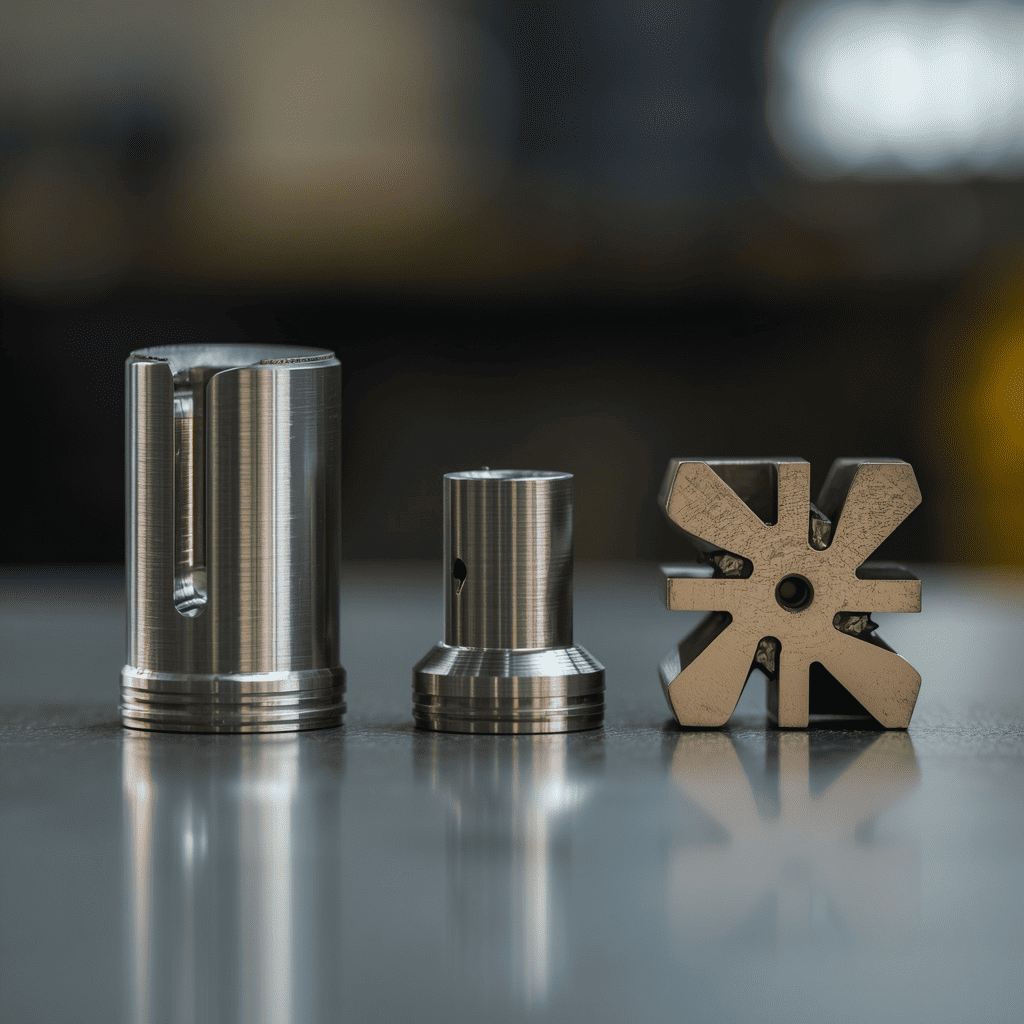
Mold and die manufacturing is EDM's home turf — sinker EDM cuts the precise cavities in hardened tool steel that injection molds and stamping dies require. Aerospace relies on EDM for cooling holes in turbine blades (a hole-drilling EDM specialty) and for machining superalloys that are difficult or impossible to cut conventionally. Medical device manufacturing uses wire and micro-EDM for fine, precise geometry in surgical instruments and implants — see our micro EDM machining guide for how the process scales down to genuinely tiny features. Tool and die repair uses hole-drilling EDM's classic application — removing broken taps, drills, and fasteners from expensive components without damaging the surrounding material, since the process only removes the conductive metal it's targeted at.
A Common Misconception Worth Correcting
Treating EDM as simply "the slow, expensive option" and defaulting to conventional machining whenever possible is a mistake on the specific class of parts EDM is actually built for. For hardened tool steel cavities, fine internal corners, or delicate thin-wall geometry, conventional machining isn't just slower to set up correctly — it may not be capable of producing the feature at all without significant tool wear, tool breakage, or unacceptable part distortion. The right comparison isn't "EDM vs. milling, which is faster" — it's "does this specific feature, on this specific material, actually need what EDM does that nothing else can."
At JLCCNC, EDM runs alongside CNC milling and turning as part of the standard machining service, which matters specifically for parts that need both — a mold base machined conventionally, with EDM reserved for the hardened cavity detail that conventional tooling can't reach.
At JLCCNC, EDM runs alongside CNC milling and turning as part of the standard machining service, which matters specifically for parts that need both — a mold base machined conventionally, with EDM reserved for the hardened cavity detail that conventional tooling can't reach.Precision CNC Machining Service
Professional manufacturing, fast turnaround, and quality assurance.
FAQ
Is EDM faster or slower than CNC milling?
Generally slower for equivalent material volume — EDM removes material through repeated micro-erosion rather than bulk cutting. It's chosen for capability (hard materials, fine geometry) rather than speed.
Can EDM cut non-metal materials?
No — EDM requires the workpiece to be electrically conductive, since the process works by eroding material with electrical discharges. Plastics, glass, and most ceramics are not EDM candidates.
What's the difference between wire EDM and sinker EDM?
Wire EDM uses a continuously fed wire to cut 2D profiles through material, similar to an extremely precise band saw. Sinker EDM presses a shaped electrode into the material to erode a 3D cavity matching the electrode's form — used for mold cavities and complex pockets a wire can't cut.
Why is dielectric fluid used in EDM?
It insulates the spark gap so voltage can build before discharging, flushes away eroded material debris so it doesn't interfere with subsequent sparks, and cools both the electrode and workpiece during the process.
Keep Learning
Laser Engraving Aluminum: Marking Methods & Surface Effects
Key Takeaways Laser engraving usually removes base material to create a recess. Laser marking is a broader term that can describe a surface-color change or material removal, so the process name alone does not define the final result. On aluminum, alloy and surface finish affect marking contrast. A light mark on dark anodized aluminum is a common design target, but the actual appearance depends on the finish and laser process. JLCCNC laser marking produces a recessed area 0.03–0.1 mm deep. The result i......
CNC Cutting Fluid: Types, Functions, Applications, and Selection Guide
Key Takeaways Cutting fluid in machining performs four functions simultaneously: cooling the tool and workpiece, lubricating the tool-chip interface to reduce friction, carrying chips away from the cut zone, and protecting machined surfaces from corrosion between operations. Different machining operations need different fluid priorities: high-speed aluminum milling may need adhesion control and chip evacuation, threading and tapping need strong lubrication, and grinding requires both cooling and fine ......
Blind Hole Machining Guide: What Is a Blind Hole, Types of Holes, and Tapping Tips
What Is a Blind Hole? Types of Holes and CNC Hole Machining Explained In CNC machining, few operations challenge process control and tool stability as much as blind hole machining. A blind hole is a hole that terminates at a defined internal depth rather than breaking through the opposite surface. Because the cavity is enclosed at the bottom, chip evacuation, thermal behavior, tool wear, and dimensional accuracy become far more difficult to manage compared to through-hole machining. These constraints ......
Rake Angle in Machining: Machinists’ Guide to Perfect Cuts
What is Rake Angle? (minaprem) If you've ever stood in front of a CNC machine or a manual lathe, you know that the cutting tool's geometry isn't just some arbitrary design. Every angle, edge, and surface has a job to do, and one of the most important of those is the rake angle. We've been running machines long enough to know that rake angle can make or break your surface finish, tool life, and machining efficiency. In this guide, we're going to walk you through what rake angle is, how it works, and ho......
Sheet Metal vs CNC Machining: A Guide to Choosing the Right Method for Your Metal Parts
Quick Answer: Choose sheet metal for uniform-thickness enclosures, panels, and formed brackets when bends and production volume support lower unit cost. Choose CNC machining for variable wall thickness, precision bores, tight feature relationships, and complex 3D geometry. Use a hybrid design when a formed structure needs precision-machined interfaces. A quote comes back for a bracket, and it's priced as a CNC part — machined from solid aluminum, a few hours of spindle time, a per-part cost that makes......
What Steps Are Taken To Minimize Waste In CNC Machining Processes?
How to Reduce Waste in CNC Machining: 5 Practical Strategies Quick Answer: CNC machining waste is reduced mainly through DFM, near-net stock, efficient toolpaths, preventive tool maintenance, and alloy-segregated recycling. The biggest gains usually come before cutting: reduce unnecessary material removal and prevent scrap or rework. Every CNC-machined part starts as more material than it ends up being. A pocket gets milled out, a profile gets cut away, a boss gets faced down to size — and all of that......