What Are Secondary Operations in Manufacturing?
11 min
- How Do Secondary Operations Fit Into the Manufacturing Process?
- What Processes Are Considered Secondary Operations in Manufacturing?
- What Are Examples of Secondary Operations by Manufacturing Process?
- Why Are Secondary Operations Needed?
- How Are Secondary Operations Planned and Specified?
- How Do Secondary Operations Affect Cost and Lead Time?
- Secondary Operations FAQs
- Conclusion About Secondary Operations
Key Takeaways
- Secondary operations refine a part after its main production stage.
- Their classification depends on the production route.
- Typical tasks include machining, heat treatment, finishing, joining, and marking.
- Final drawing requirements help determine which added steps are needed.
- Extra stages can influence cost, lead time, handling, and inspection.
Secondary operations are additional manufacturing steps performed after an earlier production stage to bring a part to its required final condition. They may include secondary machining, heat treatment, surface finishing, marking, joining, or assembly, and they can occur between major production stages rather than only at the end of the process.
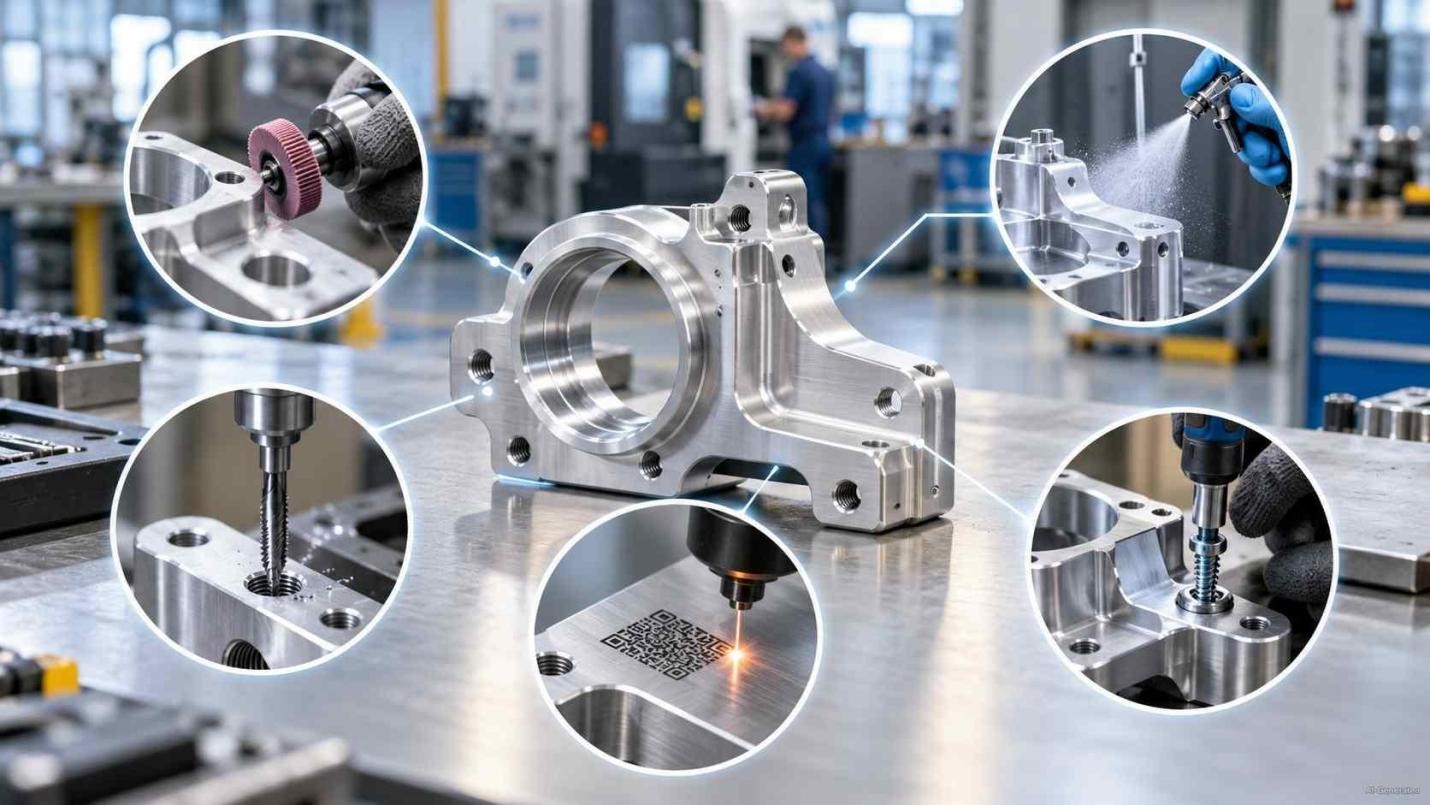
Secondary operations on a CNC machined metal part
How Do Secondary Operations Fit Into the Manufacturing Process?
Primary vs Secondary Manufacturing Processes
A primary process establishes the basic part form from starting material, such as casting metal into a mold or machining stock into the required geometry. Secondary operations follow within that manufacturing route to complete requirements that the first stage does not provide, such as tighter feature dimensions, changed material properties, surface treatment, or assembly features.
Why "Secondary" Depends on the Manufacturing Route
The label describes a process's role in the production sequence and not the process itself. For example, CNC machining can produce a component from bar stock as the main manufacturing method. It can also be secondary processing when it adds precision features to a casting or forging. The same technique can occupy a different place when the manufacturing route changes.
For example, a forged steel part may be rough-machined, heat-treated, and then finish-machined. In that route, heat treatment and finish machining are both secondary steps relative to the initial forming process, even though they occur at different points in production.
For CNC-machined parts, secondary requirements are best reviewed before production rather than added after machining is complete. JLCCNC can review the CAD model and drawing requirements together so the machining route accounts for finishing, additional machining, and critical features before quoting. Upload your CAD file to get a project-specific quote.

Precision CNC Machining Service
Professional manufacturing, fast turnaround, and quality assurance.
What Processes Are Considered Secondary Operations in Manufacturing?
Machining and Material Removal
Machining can be one of the secondary operations when an earlier process has created the basic part form. Drilling may create holes in a casting. Reaming can size a bore. Grinding can control a critical surface. Trimming can remove excess material from a molded component. If machining creates the component from stock at the start of production, however, it is the primary process.
Heat Treatment and Material Conditioning
Heat treatment becomes a secondary step when it is applied after the initial forming or material-removal stage to achieve the required material condition. Hardening, tempering, annealing, and related treatments can change hardness, ductility, wear behavior, and residual stress, while finish machining may still follow to recover final dimensions after treatment. Whether such treatment is secondary therefore comes from its place in the manufacturing sequence.
Surface Finishing, Coating, and Marking
Surface finishing is often applied after the main geometry has been established, but its position in the route depends on the finish, material, tolerances, masking requirements, and whether later machining is required. Choices include polishing, blasting, plating, anodizing, painting, powder coating, engraving, and part laser marking. For JLCCNC projects, hardcoat anodizing is typically specified at around 0.025-0.030 mm in thickness, so tolerance-critical features should be planned with the post-finish condition in mind. These processes are applied to a component created by an earlier manufacturing stage rather than defining its initial form.
Joining and Assembly
Joining and assembly apply when separately produced parts must be a subassembly or finished product. Depending on the production route, joining or assembly may also be treated as downstream operations. Their classification comes from sequence as well. They are secondary when they follow the processes used to produce the individual components being joined.
What Are Examples of Secondary Operations by Manufacturing Process?
CNC Machining
A CNC-machined component may leave the machine with edges, surfaces, identification features, or hardware still requiring additional work. Deburring, bead blasting, anodizing, passivation, laser marking, and insert installation are common choices. In this route, secondary machining may also include extra drilling, tapping, or feature work that demands another setup.
Casting
Castings follow a different path. Gates, risers, flash, scale, and rough regions can remain after solidification. Fettling, gate and riser removal, blasting, grinding, and secondary machining processes such as boring or face milling can prepare selected features for the specified geometry.
Forging
Forged blanks introduce another set of follow-up tasks. Coining can refine local detail. Straightening can address distortion. Shot blasting can remove scale.
Nondestructive testing may follow these steps as a quality-verification activity, but it is better classified as inspection rather than as a secondary manufacturing operation.
Injection Molding
For injection-molded parts, work outside the mold may provide features, decoration, joining, or final assembly. Post-mold drilling or tapping, threaded inserts, pad printing, laser engraving, heat staking, ultrasonic welding, and subassembly are examples, depending on the product design.
Additive Manufacturing
Additive manufacturing provides its own post-production route. Depending on the printing technology, a part may need depowdering, support removal, post-curing, stress relief, plate separation, hot isostatic pressing, or precision finishing before reaching its specified condition.
Why Are Secondary Operations Needed?
To Achieve Final Dimensions and Additional Features
An initial production method may create most of a component without meeting every dimensional requirement. Secondary machining can bring selected areas within tighter tolerances or produce features that the earlier stage cannot form in an accurate manner.
Machining allowance on a steel casting is not a universal fixed value. SFSA guidance relates the required machining allowance to factors such as casting size, casting surface condition, steel hardness, distortion tendency, and the location of the surface in the mold. The allowance should therefore be established from the casting specification and machining requirements rather than applied as a single rule-of-thumb value.
To Meet Surface, Material, or Performance Requirements
Correct geometry only may not give a component the properties needed in service. Further treatment can control hardness, residual stress, surface roughness, wear behavior, corrosion resistance, or other functional characteristics. A hardness, corrosion-resistance, wear, or surface-finish requirement should therefore be tied to the finished-part specification rather than selected only from the part geometry.
To Complete Joining, Assembly, or Final-Part Requirements
A manufactured piece must also work with neighboring components. Some secondary machining operations prepare mating areas and critical interfaces before joining or assembly. These operations help ensure that dimensions and tolerances support the intended relationship between mating parts.
How Are Secondary Operations Planned and Specified?
Drawing Callouts and Final-Part Requirements
Planning should begin with the finished part definition. Drawings or digital models can state dimensions, datums, geometric controls, threads, edge requirements, treatments, and other requirements that are important even after secondary operations. For dimensions without individual tolerance indications, ISO 2768-1:1989 specifies four tolerance classes for applicable linear and angular dimensions. It does not replace individual tolerances or specific geometric controls where tighter or functionally defined requirements are needed. General geometrical specifications should be defined according to the applicable drawing standard and requirements.
Tolerances, Surface Finish, and Material Requirements
Next, specifications should identify the required end condition for each critical feature. Dimensional limits, surface texture, hardness, coating requirements, and material condition can be assigned when function demands them. When a secondary process can change feature size, surface texture, or fit, its effect should be accounted for before processing rather than discovered during final inspection.
Process Sequence, Allowances, and Access
Production order should be planned around the features that must remain accessible and dimensionally controlled after each stage. Machining stock may need to be left on selected surfaces, datum features may need to remain usable for later setups, and heat treatment or surface finishing may require additional allowance before final machining. The required sequence should follow the finished-part requirements rather than a fixed operation order.
Inspection and Acceptance Criteria
Inspection planning should be established alongside process planning rather than treated as a final step. The inspection method should match the requirements being controlled, including applicable datums, dimensional tolerances, geometric controls, surface texture, thread characteristics, coating thickness, or material condition.
For a CNC-machined part, final verification may combine CMM inspection for critical dimensions and GD&T, thread gaging for tapped features, surface-roughness measurement for specified Ra values, and coating-thickness checks after finishing.
How Do Secondary Operations Affect Cost and Lead Time?
Setup, Fixturing, and Handling
Each added production stage can need machine setup, dedicated fixtures, part loading, unloading, and movement between work areas. These activities consume labor and equipment time even when no material is being removed. For low-volume production, setup and handling costs are spread across fewer parts, so each additional operation can have a disproportionate effect on unit cost and lead time. The impact becomes more significant when a secondary process requires dedicated fixturing, outside processing, or an additional inspection stage.
Outside Processing and Supplier Coordination
The cost picture changes even further when a treatment must be performed by an outside supplier. Shipping, supplier queues, purchase coordination, receiving, and production scheduling become part of the route. Delivery performance can depend on both the manufacturer and the outside supplier's queue, processing time, and transit schedule.
Inspection, Rework, and Schedule Risk
Additional stages may also create more points where a part must be checked before moving forward. If inspection finds a nonconformance late in production, earlier manufacturing cost has been incurred. A late nonconformance can trigger rework after machining, finishing, inspection, or outside processing has already been completed, increasing both cost and schedule risk.
Number of Operations and Process Changes
Route length also affects throughput. Every process change can introduce another setup, transfer, queue, or inspection point. Combining compatible work can reduce handling and waiting time, but only when the sequence still protects datum integrity, access, finish requirements, and dimensional control.
Secondary Operations FAQs
Q: Are Secondary Operations Always Performed After the Primary Manufacturing Process?
They follow the primary step in the logic of a manufacturing route. But they do not have to appear as one group at the end. A part may move through machining, treatment, inspection, joining, and other follow-on stages at different points before final acceptance.
Q: Can CNC Machining Be a Secondary Operation?
Yes. CNC machining takes a secondary role when an earlier method has produced the basic workpiece and CNC equipment is used for later dimensional or feature work. Machining can also be a primary production method when material removal creates the component from stock.
Q: What Are Common Secondary Operations After CNC Machining?
Common secondary operations after CNC machining include deburring, surface finishing, anodizing, laser marking, passivation where applicable, and additional drilling, tapping, or feature machining when the first setup does not produce the required final condition. The appropriate sequence depends on the material, tolerances, surface requirements, and assembly function of the part.
Q: Is Surface Finishing Considered a Secondary Operation?
Yes, when finishing follows the main production stage to achieve a specified surface condition. Depending on the part, this may include polishing, blasting, painting, powder coating, anodizing, or other treatments.
Q: What Is the Difference Between Secondary Operations and Post-Processing?
The terms can overlap, but their use depends on the manufacturing context. Secondary operations describe follow-up manufacturing steps within a production route, while post-processing generally refers to additional work performed after a part has been produced by a particular process. For example, in additive manufacturing, post-processing can include support removal, thermal treatment, machining, and surface finishing.
Q: Do All Manufactured Parts Require Secondary Operations?
No. A component that leaves its primary process with the required geometry, properties, surface condition, and functional features may need no further production work. The need for additional stages comes from the finished-part spec and the capability of the manufacturing method.
Q: Can CNC Machining Be a Secondary Operation After Casting or Forging?
Yes. A casting or forging may provide the near-net form. It can leave areas for CNC work where greater dimensional control is needed. Tasks can include finishing bores, faces, holes, threads, bearing locations, or precision features that were intentionally left for later machining.
Precision CNC Machining Service
Professional manufacturing, fast turnaround, and quality assurance.
Conclusion About Secondary Operations
Secondary operations are part of the manufacturing route, not simply cleanup after the primary process. If a finish, heat treatment, insert, or follow-up machining step can change a critical feature, that effect should be considered before the first operation is planned.
For CNC-machined parts, this is especially important when secondary work may affect critical features or fits. Upload your CAD files to get an instant CNC machining quote and DFM feedback from JLCCNC engineers.
Keep Learning
Laser Engraving Aluminum: Marking Methods & Surface Effects
Key Takeaways Laser engraving usually removes base material to create a recess. Laser marking is a broader term that can describe a surface-color change or material removal, so the process name alone does not define the final result. On aluminum, alloy and surface finish affect marking contrast. A light mark on dark anodized aluminum is a common design target, but the actual appearance depends on the finish and laser process. JLCCNC laser marking produces a recessed area 0.03–0.1 mm deep. The result i......
CNC Cutting Fluid: Types, Functions, Applications, and Selection Guide
Key Takeaways Cutting fluid in machining performs four functions simultaneously: cooling the tool and workpiece, lubricating the tool-chip interface to reduce friction, carrying chips away from the cut zone, and protecting machined surfaces from corrosion between operations. Different machining operations need different fluid priorities: high-speed aluminum milling may need adhesion control and chip evacuation, threading and tapping need strong lubrication, and grinding requires both cooling and fine ......
Blind Hole Machining Guide: What Is a Blind Hole, Types of Holes, and Tapping Tips
What Is a Blind Hole? Types of Holes and CNC Hole Machining Explained In CNC machining, few operations challenge process control and tool stability as much as blind hole machining. A blind hole is a hole that terminates at a defined internal depth rather than breaking through the opposite surface. Because the cavity is enclosed at the bottom, chip evacuation, thermal behavior, tool wear, and dimensional accuracy become far more difficult to manage compared to through-hole machining. These constraints ......
Rake Angle in Machining: Machinists’ Guide to Perfect Cuts
What is Rake Angle? (minaprem) If you've ever stood in front of a CNC machine or a manual lathe, you know that the cutting tool's geometry isn't just some arbitrary design. Every angle, edge, and surface has a job to do, and one of the most important of those is the rake angle. We've been running machines long enough to know that rake angle can make or break your surface finish, tool life, and machining efficiency. In this guide, we're going to walk you through what rake angle is, how it works, and ho......
Sheet Metal vs CNC Machining: A Guide to Choosing the Right Method for Your Metal Parts
Quick Answer: Choose sheet metal for uniform-thickness enclosures, panels, and formed brackets when bends and production volume support lower unit cost. Choose CNC machining for variable wall thickness, precision bores, tight feature relationships, and complex 3D geometry. Use a hybrid design when a formed structure needs precision-machined interfaces. A quote comes back for a bracket, and it's priced as a CNC part — machined from solid aluminum, a few hours of spindle time, a per-part cost that makes......
What Steps Are Taken To Minimize Waste In CNC Machining Processes?
How to Reduce Waste in CNC Machining: 5 Practical Strategies Quick Answer: CNC machining waste is reduced mainly through DFM, near-net stock, efficient toolpaths, preventive tool maintenance, and alloy-segregated recycling. The biggest gains usually come before cutting: reduce unnecessary material removal and prevent scrap or rework. Every CNC-machined part starts as more material than it ends up being. A pocket gets milled out, a profile gets cut away, a boss gets faced down to size — and all of that......