What Is Tempering? Metal Tempering Process and Applications
10 min
- What Is Tempering?
- Why Is Steel Tempered?
- How Does the Tempering Process Work?
- How Does Tempering Temperature Affect Steel Properties?
- How Does Tempering Affect CNC Machined Parts?
- Tempering vs Other Heat Treatment Processes
- Where Is Tempered Steel Used?
- Tempering FAQs
- Conclusion About Tempering
Key Takeaways
- In conventional quench-and-temper treatment, tempering reheats previously hardened steel below its lower critical temperature.
- Temperature and holding time affect the final mechanical properties.
- Tempered steel is used for tools, gears, shafts, and loaded components.
- CNC planning must account for heat-treatment distortion and final tolerances.
- Tempering differs from quenching, annealing, and normalizing in purpose and sequence.
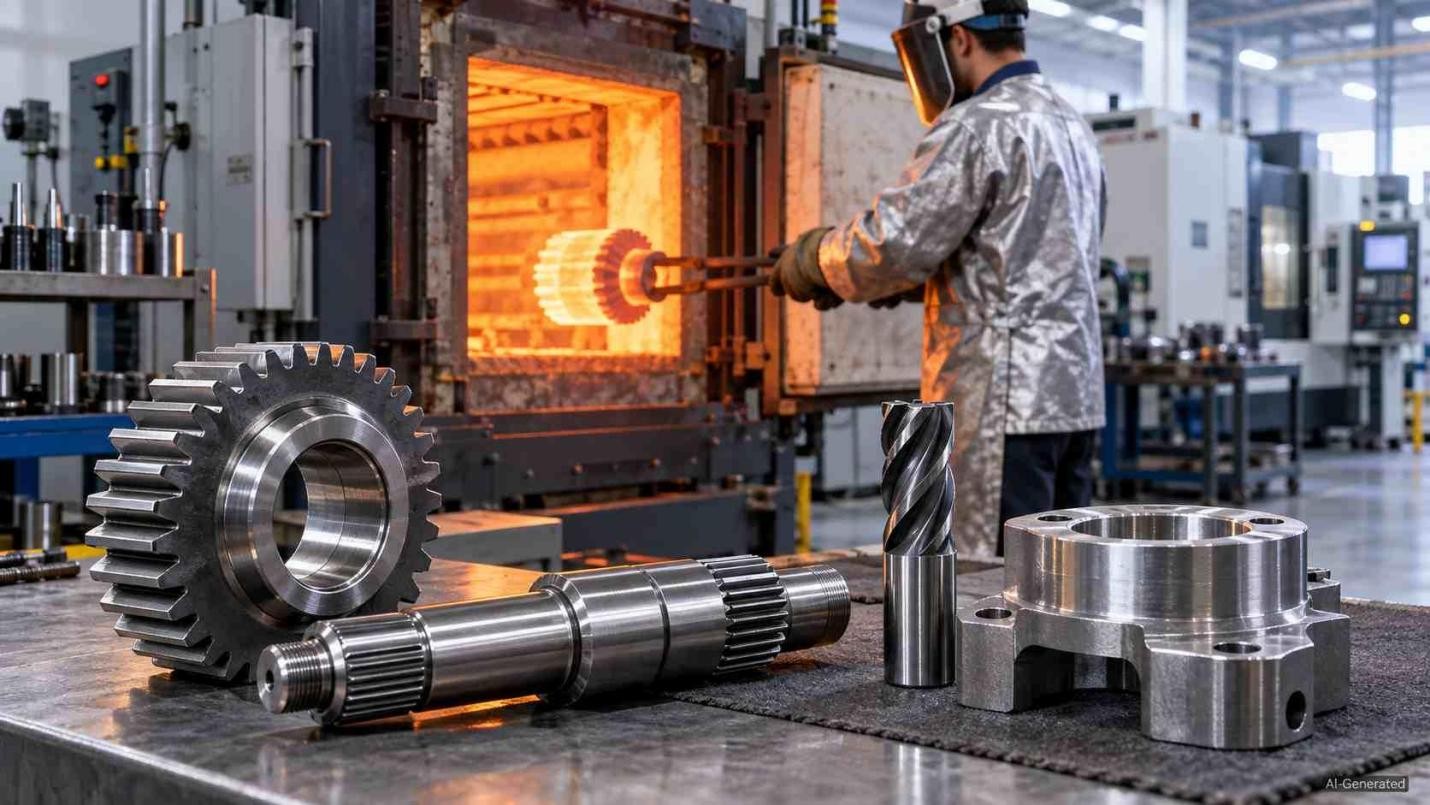
Tempering steel parts in an industrial furnace
Hardening gives steel high hardness. But the quenched condition can leave it brittle and internally stressed. Tempering addresses this condition. It reheats hardened steel below the lower critical temperature, holds it for a selected period, and cools it under controlled conditions. In practice, tempering adjusts the properties of hardened steel by reducing as-quenched hardness and residual stress while increasing toughness and ductility. The target condition depends on the steel grade, tempering temperature, holding time, and service requirements.
What Is Tempering?
In conventional quench-and-temper treatment, tempering is a subcritical heat treatment applied to previously hardened steel. The steel is reheated below its lower critical temperature to adjust the condition left by quench hardening. Tempering reduces as-quenched brittleness and relieves part of the residual stress while bringing hardness, strength, toughness, and ductility into the required service range. Some reduction in hardness and strength is expected. The result is tempered steel with a property balance suited to its intended service.
Why Is Steel Tempered?
Reduce Brittleness After Hardening
Quenching produces very hard martensite. But the as-quenched structure can have poor fracture toughness and limited resistance to impact. Metal tempering lowers this brittleness. It changes the hardened microstructure in a controlled way while retaining enough hardness for wear resistance and demanding service conditions.
Improve Toughness and Ductility
A hardened component might need to resist cracking as well as surface wear. Tempering trades part of the as-quenched hardness for better ductility and toughness. It produces a more useful hardness-toughness balance for parts exposed to shock, bending, or repeated loading.
Relieve Internal Stress
Rapid quenching can leave residual stresses from uneven thermal contraction and phase changes within the steel. Metal tempering allows part of these stresses to relax. Tempering reduces residual stress that can contribute to quench cracking and later dimensional change. It can improve dimensional stability, but heat-treatment distortion still needs to be accounted for during machining and inspection.

Precision CNC Machining Service
Heat treatment can affect how a CNC part is machined and finished, especially when tight dimensions are involved. JLCCNC can review the part before production to identify potential machining and heat-treatment considerations.
How Does the Tempering Process Work?
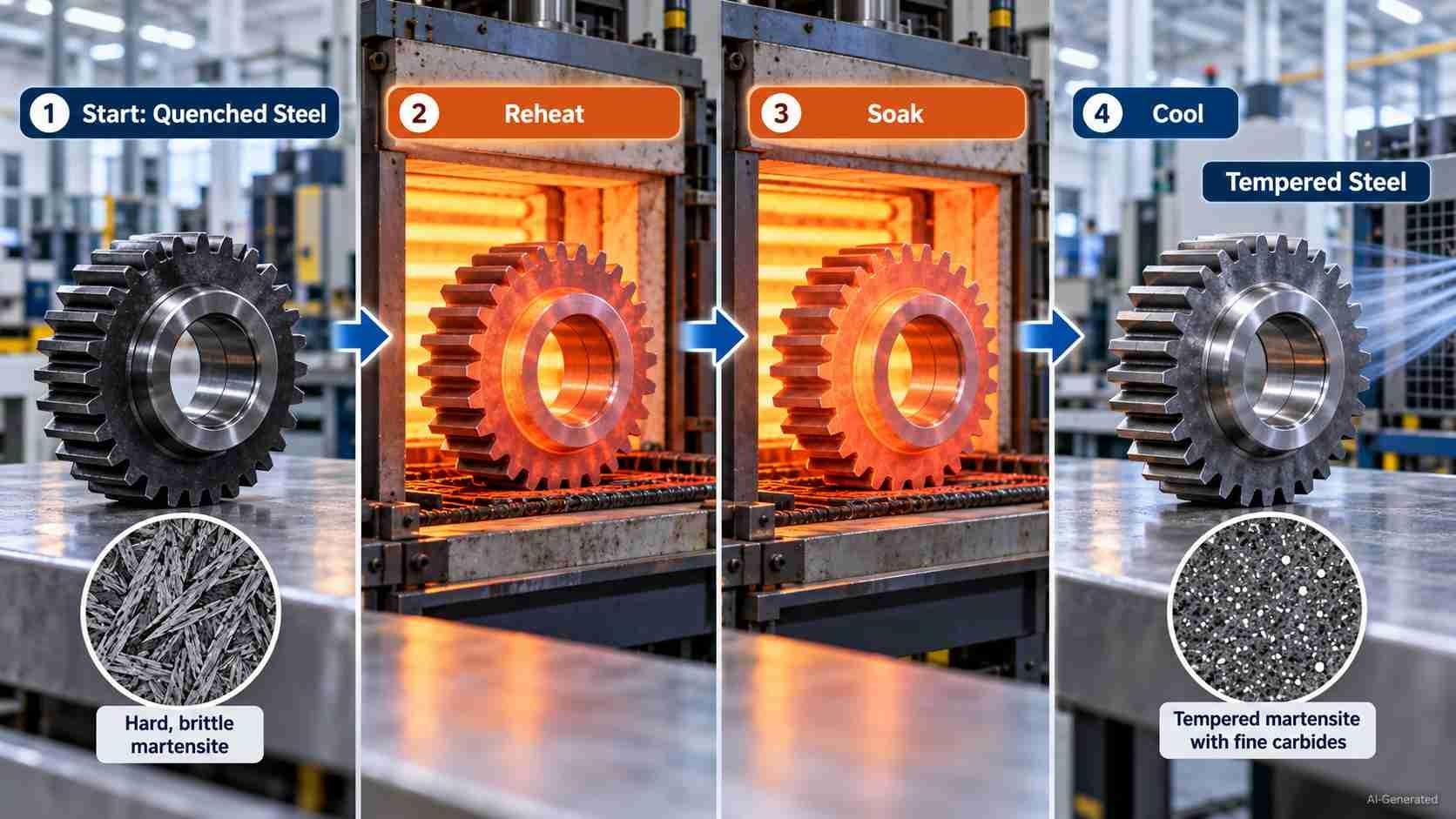
Steel tempering process from quenching to cooling
Heating and Holding at the Tempering Temperature
The tempering process begins by reheating hardened steel to a selected temperature below the lower critical temperature, Ac1. Once the part reaches the target temperature throughout its section, it is held there for a specified period to allow the intended metallurgical changes to develop. The holding period allows the selected tempering reactions to proceed through the part thickness.
Cooling After Tempering
After soaking, the component is cooled using the method specified for the steel grade and heat-treatment cycle. Many conventional steel tempering cycles are air-cooled, but cooling practice can be important for alloy steels that are susceptible to temper embrittlement. This stage completes the thermal cycle without heating the material into the austenitic region again.
What Happens to the Steel Microstructure
During tempering, supersaturated martensite undergoes carbon redistribution and carbide precipitation. The reactions and resulting carbides depend on tempering temperature, holding time, and alloy composition. Depending on the steel and thermal cycle, retained austenite may decompose during tempering or during subsequent cooling. Higher-temperature tempering can promote recovery and further carbide development, while some alloy steels may require multiple tempering cycles to achieve the specified microstructure and properties.
Starting With Quenched or Hardened Steel
All of these stages assume a hardened starting condition, which is dominated by martensite with possible retained austenite and undissolved carbides. The tempering process acts on this nonequilibrium structure through controlled reheating and holding. This produces a tempered martensite whose final microstructure depends on thermal cycle and alloy chemistry.
How Does Tempering Temperature Affect Steel Properties?
Note
Tempering temperature is grade-specific, so these ranges should be treated as general examples rather than universal settings.
Low-Temperature Tempering
At lower tempering temperatures (which might be between 150-250°C for many steels), hardness and tensile strength are comparatively high. Brittleness declines to a limited degree. This range is often selected when relatively high hardness must be retained, such as in some tool and wear-resistant applications. The required temperature must be selected for the specific steel grade and target mechanical properties.
Medium-Temperature Tempering
Going to an intermediate range produces more pronounced softening. Hardness and strength decrease as toughness and ductility increase. The relationship is not identical for every grade. Alloy steels which contain carbide-forming elements can show secondary hardening at certain temperatures. This makes material chemistry an important part of temperature selection.
High-Temperature Tempering
At higher temperatures, which might be around 500-650°C for conventional quenched steels, recovery and carbide development progress further. Higher-temperature tempering generally produces a tougher, more ductile condition with lower hardness and strength, although the exact response depends strongly on alloy composition. Engineers therefore choose the final temperature from the steel grade, loading conditions, wear demands, and required mechanical properties. One setting should not be applied to every component.
How Does Tempering Affect CNC Machined Parts?
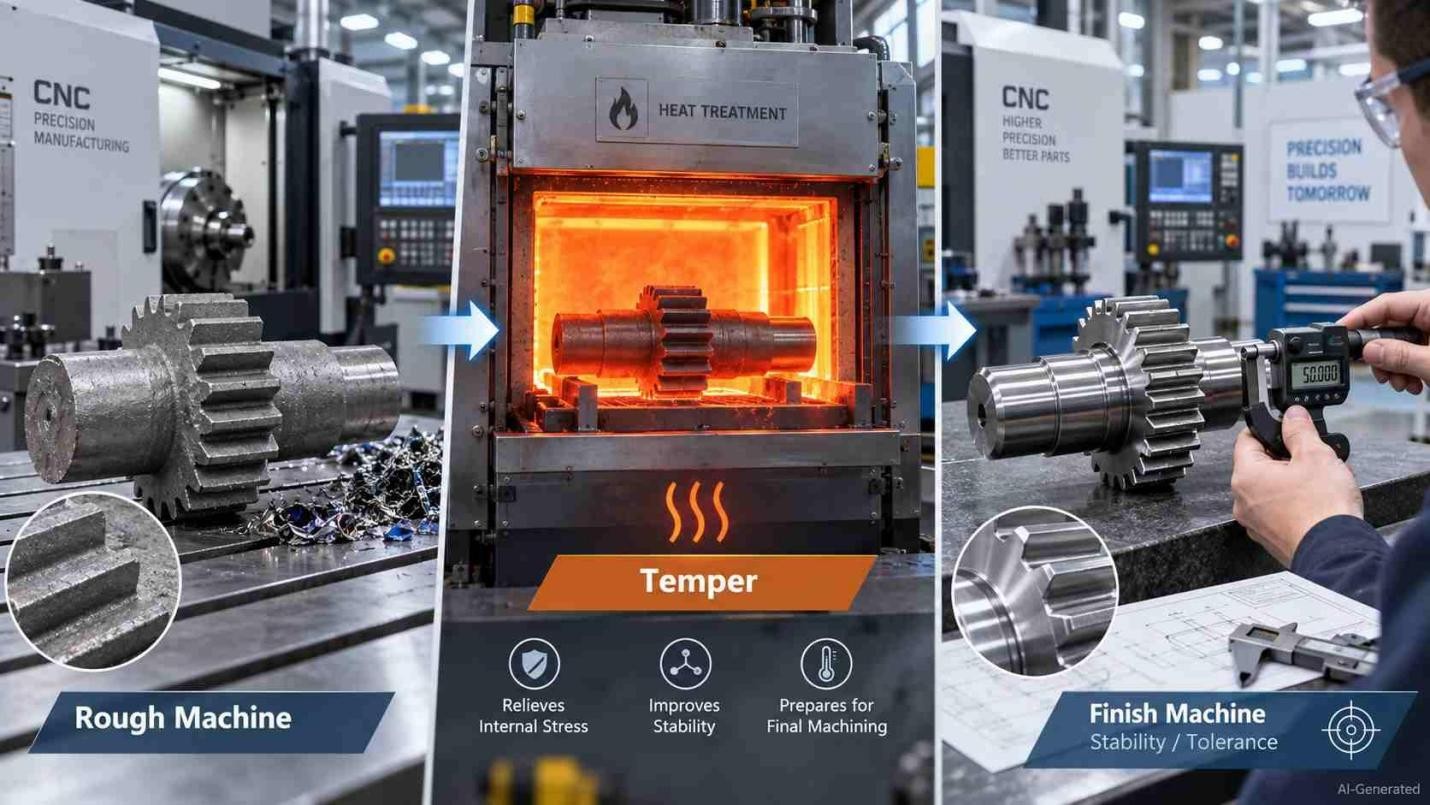
Tempering workflow for CNC machined steel parts
Tempering can change the hardness, residual stress, and dimensional stability of hardened steel, so the heat-treatment cycle should be considered when planning the machining process. The exact sequence depends on the steel grade, part geometry, required hardness, and final tolerance.
Machining Sequence and Final Finishing
For some heat-treated steel parts, rough machining is performed before hardening and tempering, with enough material left on critical surfaces for final machining or grinding after heat treatment. This approach allows heat-treatment movement to be corrected during the finishing stage. Pre-hardened materials and surface-hardening processes may require a different sequence.
Final machining method also depends on the hardness after tempering. Parts that remain relatively hard may require tooling and cutting parameters suited to hardened steel, while grinding may be preferred for highly critical surfaces.
Distortion, Tolerance, and Final Inspection
Heat treatment can cause dimensional movement or geometric distortion even when residual stress is reduced by tempering. For tight CNC tolerances, the machining plan should account for expected movement rather than treating the post-machining dimensions as fixed before heat treatment.
Critical features such as bores, mounting faces, and datum-related surfaces should be verified after the final heat-treatment and finishing operations. Where necessary, machining allowance can be left on functional surfaces so that the remaining stock can be removed after heat treatment to achieve the required geometry and tolerance.
Tempering vs Other Heat Treatment Processes
| Heat Treatment | Main Purpose | Position in Heat Treatment Sequence | Typical Heating and Cooling Approach | Resulting Effect on Steel Properties |
|---|---|---|---|---|
| Tempering | Adjust the properties of hardened steel by improving toughness and ductility as well as relieving quenching stresses. | Follows quench hardening. | Reheats steel below the lower critical temperature, holds it for a selected time, and cools it at a suitable rate. | Reduces as-quenched hardness to a controlled level and improves toughness, ductility, stress condition, and dimensional stability. |
| Quenching | Rapidly cool austenitized steel to produce a hardened microstructure. | Follows heating into the austenitizing range and precedes tempering. | Steel is heated to the required austenitizing temperature and rapidly cooled using a quenching medium. | Produces high hardness and strength, though the resulting condition can contain residual stress and greater brittleness. |
| Annealing | Reduce hardness, improve machinability or formability, and obtain a more stable microstructure. | Used before machining, forming, or further heat treatment, depending on the manufacturing route. | Full annealing heats steel into the austenitizing range, followed by very slow furnace cooling. | Produces a softer condition with improved machinability; full annealing typically produces a relatively coarse ferrite-pearlite structure in suitable carbon and alloy steels. |
| Normalizing | Refine and equalize the microstructure and grain condition of steel. | Used as a preparatory or property-adjustment treatment before machining or further heat treatment. | Steel is heated above its transformation range and cooled in air. | Produces a uniform and refined structure and properties that differ from the softer condition obtained through full annealing. |
Where Is Tempered Steel Used?
Cutting Tools and Tooling
Cutting tools provide a practical example of why steel is tempered. High-speed and cold-work tool steels are quenched and tempered for drills, taps, reamers, milling cutters, punches, dies, and shear blades. These tools need enough hardness to resist wear while retaining sufficient toughness to reduce edge chipping and fracture in service.
Gears, Shafts, and Machine Components
Shafts, axles, and many machine components are commonly made from quenched-and-tempered alloy steels when a through-hardened combination of strength and toughness is required. Gears may use a different heat-treatment route, such as carburizing followed by quenching and tempering, when the design calls for a hard wear-resistant surface and a tougher core.
Automotive and Industrial Components
Q&T steels are also used for components subjected to repeated mechanical loading, including some connecting rods, shafts, machine-tool components, and other structural parts. The required heat-treatment condition depends on the component geometry, load case, wear requirement, and whether a hardened surface or through-hardened structure is needed. These components may encounter vibration, cyclic loading, impact, and abrasive contact. This makes tempered steel useful when a component must withstand cyclic or impact loading without giving up all of the hardness gained during hardening.
Tempering FAQs
Does Tempering Reduce Steel Hardness?
Usually, yes. For many quenched steels, increasing tempering temperature reduces hardness and strength while increasing toughness and ductility. However, some alloy tool steels can show secondary hardening at specific temperatures, so the response is not always a simple monotonic decrease in hardness.
Can Steel Be Tempered More Than Once?
Yes. Multiple tempering cycles are used for some tool and alloy steels to achieve the required hardness and toughness and to further stabilize the microstructure after the initial temper. ASM heat-treatment guidance specifically recognizes multiple tempering as an established practice.
Does Tempering Always Follow Quenching?
In conventional quench-and-temper treatment, tempering follows quenching. ASM also uses the term for certain subcritical treatments applied to normalized steel and for stress relief after welding, forming, or machining. These applications should not be treated as identical to conventional martensitic tempering.
Is Aluminum Tempered Like Steel?
No. Aluminum uses temper designations such as T4 and T6 to describe specific processing conditions, including solution heat treatment and aging. These temper designations are not the same process as tempering hardened martensitic steel.
How Long Does Steel Tempering Take?
Tempering time depends on the steel grade, section thickness, tempering temperature, and required mechanical properties. The holding period is selected to allow the part to reach the required temperature throughout its section and for the intended tempering reactions to develop.
Precision CNC Machining Service
Planning a CNC-machined steel part that requires hardening and tempering? Upload your CAD files to get an instant CNC machining quote and DFM feedback from JLCCNC engineers.
Conclusion About Tempering
Tempering is used to bring hardened steel into a condition that is suitable for its intended service, rather than simply retaining the highest possible hardness. For CNC-machined parts, the heat-treatment condition also affects how much stock should be left for finishing and when critical dimensions should be verified. A suitable tempering treatment therefore needs to be considered as part of the overall manufacturing process, not as an isolated heat-treatment step.
Keep Learning
Laser Engraving Aluminum: Marking Methods & Surface Effects
Key Takeaways Laser engraving usually removes base material to create a recess. Laser marking is a broader term that can describe a surface-color change or material removal, so the process name alone does not define the final result. On aluminum, alloy and surface finish affect marking contrast. A light mark on dark anodized aluminum is a common design target, but the actual appearance depends on the finish and laser process. JLCCNC laser marking produces a recessed area 0.03–0.1 mm deep. The result i......
CNC Cutting Fluid: Types, Functions, Applications, and Selection Guide
Key Takeaways Cutting fluid in machining performs four functions simultaneously: cooling the tool and workpiece, lubricating the tool-chip interface to reduce friction, carrying chips away from the cut zone, and protecting machined surfaces from corrosion between operations. Different machining operations need different fluid priorities: high-speed aluminum milling may need adhesion control and chip evacuation, threading and tapping need strong lubrication, and grinding requires both cooling and fine ......
Blind Hole Machining Guide: What Is a Blind Hole, Types of Holes, and Tapping Tips
What Is a Blind Hole? Types of Holes and CNC Hole Machining Explained In CNC machining, few operations challenge process control and tool stability as much as blind hole machining. A blind hole is a hole that terminates at a defined internal depth rather than breaking through the opposite surface. Because the cavity is enclosed at the bottom, chip evacuation, thermal behavior, tool wear, and dimensional accuracy become far more difficult to manage compared to through-hole machining. These constraints ......
Rake Angle in Machining: Machinists’ Guide to Perfect Cuts
What is Rake Angle? (minaprem) If you've ever stood in front of a CNC machine or a manual lathe, you know that the cutting tool's geometry isn't just some arbitrary design. Every angle, edge, and surface has a job to do, and one of the most important of those is the rake angle. We've been running machines long enough to know that rake angle can make or break your surface finish, tool life, and machining efficiency. In this guide, we're going to walk you through what rake angle is, how it works, and ho......
Sheet Metal vs CNC Machining: A Guide to Choosing the Right Method for Your Metal Parts
Quick Answer: Choose sheet metal for uniform-thickness enclosures, panels, and formed brackets when bends and production volume support lower unit cost. Choose CNC machining for variable wall thickness, precision bores, tight feature relationships, and complex 3D geometry. Use a hybrid design when a formed structure needs precision-machined interfaces. A quote comes back for a bracket, and it's priced as a CNC part — machined from solid aluminum, a few hours of spindle time, a per-part cost that makes......
What Steps Are Taken To Minimize Waste In CNC Machining Processes?
How to Reduce Waste in CNC Machining: 5 Practical Strategies Quick Answer: CNC machining waste is reduced mainly through DFM, near-net stock, efficient toolpaths, preventive tool maintenance, and alloy-segregated recycling. The biggest gains usually come before cutting: reduce unnecessary material removal and prevent scrap or rework. Every CNC-machined part starts as more material than it ends up being. A pocket gets milled out, a profile gets cut away, a boss gets faced down to size — and all of that......