What Is Sheet Metal Fabrication? The Complete Guide
10 min
- What Is Sheet Metal Fabrication? The Complete Guide
- What Is Sheet Metal Fabrication?
- How Sheet Metal Fabrication Works — From Flat Sheet to Finished Part
- Core Sheet Metal Fabrication Processes
- Common Sheet Metal Materials
- Sheet Metal Fabrication vs. CNC Machining
- Industries & Applications
- Choosing a Sheet Metal Fabrication Partner
- FAQ
What Is Sheet Metal Fabrication? The Complete Guide
Somewhere between a CAD file and a working enclosure sitting on your bench, a flat piece of metal gets cut, bent, joined, and finished into something that actually does a job. That's sheet metal fabrication — and if you've never ordered a part before, the term can feel bigger than it needs to be. Ask five people what "sheet metal fabrication" covers and you'll get five different answers: some think laser cutting, some think welding, some just picture a guy in a workshop with a brake press.
They're all half right. Sheet metal fabrication isn't one process — it's a family of processes that turn flat stock into three-dimensional parts, and which ones you need depends entirely on what you're building. A simple L-bracket might only need cutting and one bend. A server chassis might need cutting, multiple bends, welded seams, powder coating, and a dozen tapped holes. Same starting material, completely different journeys.
This guide walks through what sheet metal fabrication actually is, how the process runs from flat sheet to finished part, and where each technique fits — with links out to the deeper guides if you want to go further on any single step.
Need Sheet Metal Parts Built Fast?
Before diving into the theory, if you’re here because you need parts manufactured, JLCCNC can help. We process thousands of flat patterns every week, providing rapid sheet metal fabrication alongside CNC machining for complex hybrid assemblies.

Precision Sheet Metal Fabrication
Professional manufacturing, fast turnaround, and quality assurance.
What Is Sheet Metal Fabrication?
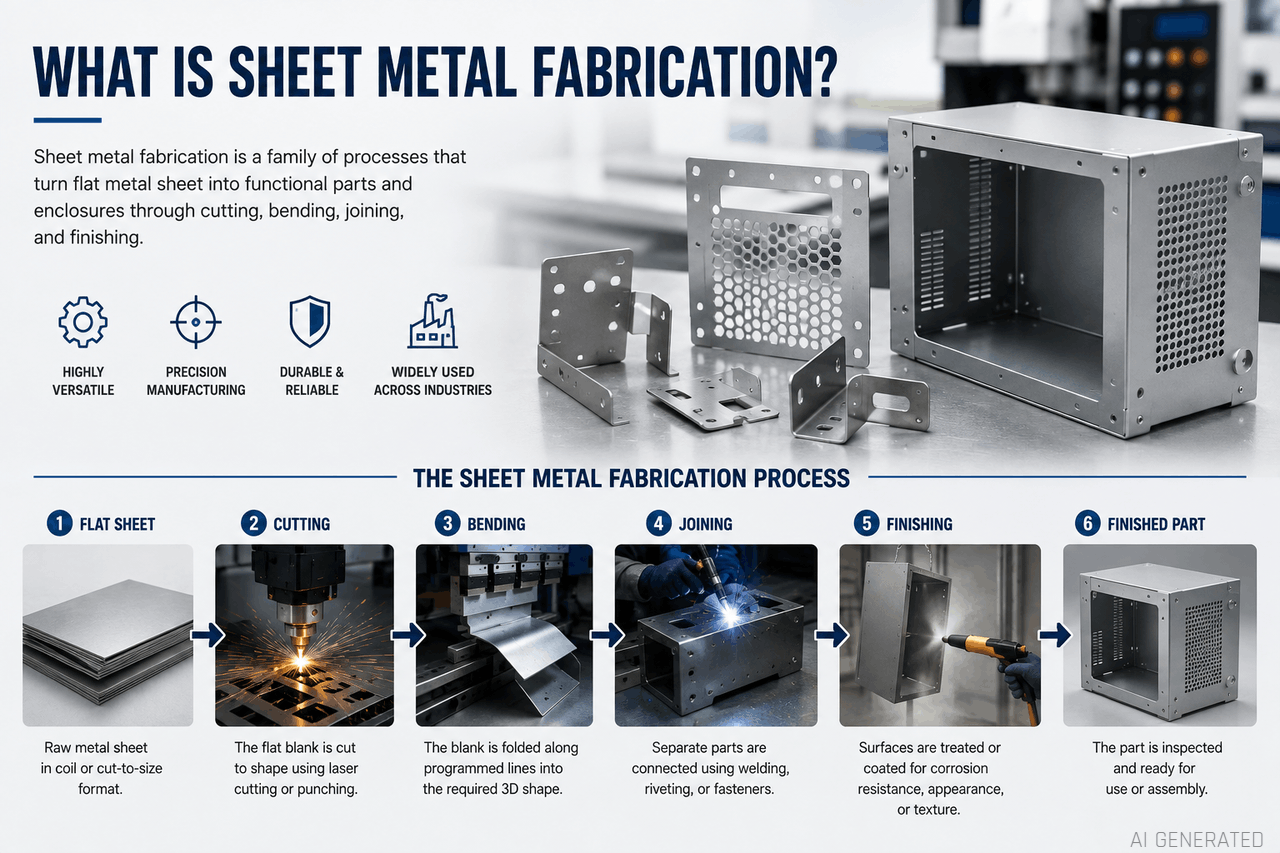
Sheet metal fabrication is the process of forming flat metal stock — typically under 6mm thick, though definitions vary by shop — into a functional part or enclosure using a combination of cutting, bending, joining, and finishing operations. The "sheet" in the name refers to the raw material format: metal rolled thin enough to be cut and bent without needing to be melted or cast.
That distinction matters more than it sounds. Sheet metal parts are formed, not carved. A CNC-machined bracket starts as a solid block and has material removed until the final shape emerges. A sheet metal bracket starts as a flat blank and gets its shape by folding, punching, and joining — closer to origami with steel than to sculpture. That difference in approach is also what drives the cost difference: sheet metal fabrication generates far less scrap than machining a part from solid stock, which is a big part of why it's the default choice for enclosures, panels, brackets, and chassis across almost every industry.
How Sheet Metal Fabrication Works — From Flat Sheet to Finished Part
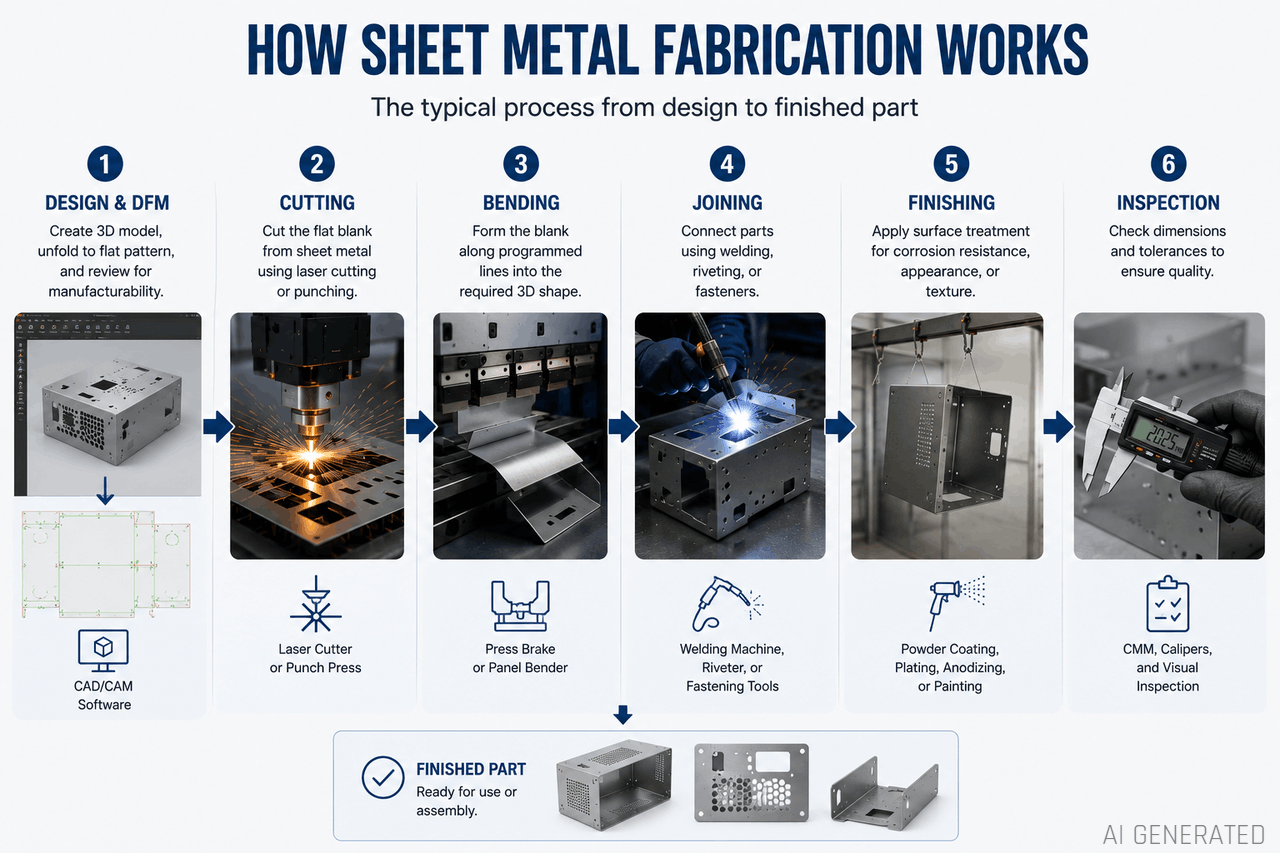
Every sheet metal part, no matter how simple or complex, moves through some version of the same sequence. The order rarely changes; what changes is how many times you repeat each step and how much precision each one demands.
| Stage | What Happens | Typical Equipment |
|---|---|---|
| Design & DFM | The flat pattern is unfolded from the 3D model, and features are checked against bend radii, hole placement, and material minimums | CAD/CAM software, DFM review |
| Cutting | The flat blank is cut to shape from raw stock | Laser cutter, punch press, waterjet |
| Bending | The flat blank is folded along programmed lines into its 3D form | Press brake, panel bender |
| Joining | Separate pieces are connected into one assembly | Welding, riveting, fasteners |
| Finishing | Surfaces are treated for corrosion resistance, appearance, or texture | Deburring, powder coating, anodizing, plating |
| Inspection | Dimensions and tolerances are checked against the drawing | CMM, calipers, visual inspection A part that's just a single bent bracket might only touch three of those stages. A welded enclosure with a powder-coated finish touches all six, and often loops back through inspection more than once — a deburring pass gets missed, a bend angle drifts half a degree out of spec, and the batch goes back for rework before it ever reaches finishing. That kind of iteration is normal, not a sign something went wrong; it's part of why DFM review at the front end saves so much time on the back end. |
Core Sheet Metal Fabrication Processes
Each stage above is really its own discipline, and each one has enough depth to fill a guide on its own. Here's a quick map of what each one covers and where to go deeper.
Cutting is where the flat blank gets its outline. Laser cutting dominates for its speed and edge quality on most sheet thicknesses, though plasma and waterjet each have their place — plasma for thicker material where laser starts to lose efficiency, waterjet for materials that laser's heat would damage. Our guide on laser cutting technology in sheet metal processing breaks down when each cutting method actually makes sense.
Bending turns a flat blank into a 3D shape using a press brake that clamps the sheet between a punch and die. The relationship between bend radius, material thickness, and grain direction is one of the more common places designers get tripped up — specify a radius tighter than the material can handle and you get cracking at the bend line instead of a clean fold. Our bending and forming technology guide covers the different bending methods and where they're each suited.
Joining connects multiple formed pieces into a single assembly. Welding gives you the strongest, most permanent joint, but it also introduces heat that can warp thin material if it's not managed carefully. Riveting and fastening skip the heat problem entirely, trading some strength for speed and predictability — useful when you're joining dissimilar metals that wouldn't weld cleanly together anyway. Hardware insertion (using PEM nuts, standoffs, and studs) is also a critical fastening process, allowing you to add strong, reliable threads to thin sheet metal without the distortion of welding. See our guides on sheet metal welding and sheet metal joining methods for tradeoffs.
Finishing is the step that gets skipped in early prototypes and then causes problems in production. Raw cut and bent metal has sharp edges, visible tool marks, and — depending on the material — an open invitation to corrosion. Deburring, powder coating, anodizing, and plating all address different parts of that problem. Our sheet metal finishing guide walks through which finish suits which use case.
Common Sheet Metal Materials
Material choice shapes almost every decision downstream of it — how tight a bend radius you can hold, whether you'll need to worry about corrosion, how the part will weld, what it'll cost. Cold rolled steel is the default for general-purpose enclosures and brackets where cost matters more than corrosion resistance. Stainless steel earns its higher price tag in food-processing, medical, and outdoor applications where corrosion resistance is non-negotiable. Aluminum splits the difference — lighter than steel, naturally corrosion-resistant, but softer and pricier per unit weight in some grades. Galvanized steel adds a zinc coating to ordinary steel, which is worth understanding on its own since the coating changes how the metal welds and finishes compared to bare steel.
If you're still deciding between materials, our guide on aluminum vs. stainless steel for sheet metal and our breakdown of the different types of sheet metal go deeper into how to match material to application.
Not sure which material will hold up best in your application? Upload your CAD file to JLCCNC for a free DFM review and expert material recommendations.
Sheet Metal Fabrication vs. CNC Machining
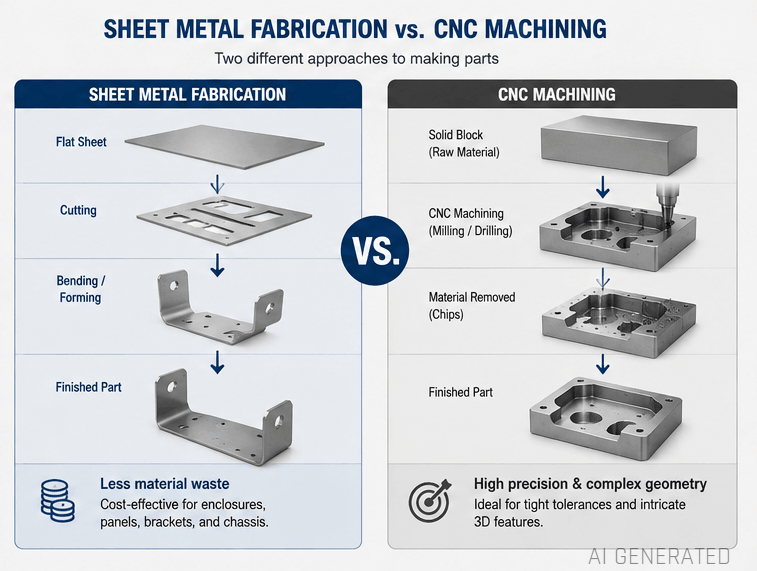
The two processes get compared constantly because they solve overlapping problems — enclosures, brackets, panels — but they solve them differently, and picking the wrong one usually shows up as either wasted budget or a part that can't do what you need.
Sheet metal fabrication wins on large, thin-walled parts with uniform thickness: enclosures, chassis, panels, anything where you're mostly bending flat stock into a box or bracket shape. It's fast and cheap at volume because there's very little waste — you're forming material, not cutting most of it away.
CNC machining wins where you need tight tolerances, complex internal features, or a part that sheet metal simply can't form — deep pockets, threaded bosses, precise mounting surfaces. It costs more per part in most cases, but for a component where a bent tab just won't hold the tolerance you need, machining is the only real option.
A lot of real products end up using both: a sheet metal chassis for the main structure, with CNC-machined brackets or mounting plates bolted in wherever precision actually matters. Our detailed sheet metal vs. CNC machining comparison walks through the decision in more depth, including a few cases where combining both processes on one assembly is the smarter call.
Industries & Applications
Sheet metal fabrication shows up almost everywhere flat structural or protective parts are needed. Electronics enclosures and server chassis rely on it for lightweight, cost-effective housings. HVAC systems are built almost entirely from sheet metal ductwork. Automotive body panels, industrial equipment covers, control cabinets, and architectural cladding all draw on the same core processes — cut, bend, join, finish — just tuned to different tolerances, materials, and volumes depending on the industry's demands.
Choosing a Sheet Metal Fabrication Partner
Once you've got a design ready, the practical question becomes who actually builds it. The things worth checking before committing to a shop: what materials and thicknesses they actually stock (not just list on a website), whether they run DFM checks before quoting so problems get caught before production instead of after, and how their pricing scales from prototype quantities to full production runs — some shops are efficient at one and expensive at the other.
At JLCCNC, sheet metal fabrication runs alongside CNC machining on the same platform, which is useful specifically for the hybrid assemblies mentioned above — a sheet metal enclosure with CNC-machined mounting points doesn't need to be split across two vendors and two shipping cycles.
Ready to bring your flat pattern to life? Upload your CAD file today to get an instant quote with material and finish options laid out, and see where your design might need adjusting before it ever hits the shop floor.
Precision Sheet Metal Fabrication
Professional manufacturing, fast turnaround, and quality assurance.
FAQ
What's the difference between sheet metal fabrication and metal fabrication?
Metal fabrication is the broader category — it includes casting, forging, and machining alongside sheet metal work. Sheet metal fabrication specifically refers to processes that form flat sheet stock, rather than working from solid blocks or molten material.
How thick can sheet metal be and still count as "sheet metal"?
There's no universal cutoff, but most fabrication shops treat anything up to about 6mm as sheet metal. Beyond that, material behaves differently under a press brake and starts overlapping with plate work.
Is sheet metal fabrication cheaper than CNC machining?
Usually, for parts that fit sheet metal's strengths — thin-walled enclosures, brackets, panels — because the process generates far less scrap. For parts needing tight tolerances or complex 3D features, machining often ends up more cost-effective despite the higher per-part price, since sheet metal simply can't hold the geometry without extra secondary operations.
What's the most common mistake in sheet metal design?
Specifying a bend radius that's too tight for the material thickness. It's an easy thing to miss in CAD, where the software will happily show you a bend that the actual metal can't physically make without cracking or thinning dangerously at the fold line.
Popular Articles
• 9 Sheet Metal Cutting Problems and Solutions
• Hole cutting in sheet metal: techniques, tolerances and applications
• Introduction to Sheet Metal Processing: Techniques and Tools for Precision
• Bending and Forming Technology in Sheet Metal Processing
• Laser cutting technology in sheet metal processing
Keep Learning
Galvanized Sheet Metal: Grades, Specs & When to Use It
Galvanized Sheet Metal: Grades, Specs & When to Use It A design engineer specs "galvanized sheet metal" on a drawing and sends it out for quotes. Three shops come back with three different prices, and one of them asks a follow-up question the others didn't: which gauge, which coating class, hot-dip or electro-galvanized? That question is the difference between a part that survives outdoors for fifteen years and one that starts showing rust spots after eighteen months — and it's the kind of detail that......
Custom Sheet Metal Fabrication: How the Process Works From Design to Delivery
Custom Sheet Metal Fabrication: How the Process Works From Design to Delivery A stock enclosure almost fits. The mounting holes are close but not quite right, the depth is half an inch too shallow, and the vendor's next size up is twice the volume you actually need. This is the point where most people start looking into custom sheet metal fabrication — not because they set out to design a part from scratch, but because nothing off the shelf actually solves the problem. Custom fabrication sounds like i......
Sheet Metal Assembly: How Fabricated Parts Come Together
Sheet Metal Assembly: How Fabricated Parts Come Together Cutting and bending gets a lot of attention because that's where a flat sheet visibly turns into a 3D part. But a single bracket by itself rarely finishes the job — most real sheet metal products are assemblies, multiple formed pieces joined into one working unit, and that assembly step is where a lot of designs quietly succeed or fail. A part that measured perfectly on its own can still not fit once it's supposed to mate with three other pieces......
Sheet Metal Bender: Types, Specs & How to Choose the Right Machine
Sheet Metal Bender: Types, Specs & How to Choose the Right Machine Every sheet metal bracket, enclosure, and panel eventually passes through a bender of some kind — that's the machine, not the process. Our guide on sheet metal bending covers how bending actually deforms metal — springback, minimum radius, bend allowance, and the core press brake and CNC press brake setups most shops run. This one goes further into the equipment side specifically: the less common bender types beyond the standard press ......
What Is Galvanized Metal? Process, Types & How It Works
What Is Galvanized Metal? Process, Types & How It Works Leave a piece of bare steel outside for a season and you'll see exactly why galvanizing exists. Rust doesn't wait for dramatic weather — a little humidity and a few weeks is enough to start eating into an unprotected surface. Galvanized metal solves that problem by giving steel a sacrificial layer of zinc that corrodes in its place, and it's done this job well enough that it's become the default choice for anything from highway guardrails to HVAC......
What Is Sheet Metal Fabrication? The Complete Guide
What Is Sheet Metal Fabrication? The Complete Guide Somewhere between a CAD file and a working enclosure sitting on your bench, a flat piece of metal gets cut, bent, joined, and finished into something that actually does a job. That's sheet metal fabrication — and if you've never ordered a part before, the term can feel bigger than it needs to be. Ask five people what "sheet metal fabrication" covers and you'll get five different answers: some think laser cutting, some think welding, some just picture......